Monday, April 3, 2017

Drying out my thought loops

They say that 90% of our thoughts are repetitive. Actually, I don’t know who “they” is, but I say that 90% of my thoughts are repetitive.

The first time I have a thought, it may be quite nice. It might be a new idea or a pleasant feeling of gratitude. It can also be not so nice, like regret over the way I’ve worded something or dread of some upcoming event.

Both of those kind of thoughts repeat, the pleasant and the unpleasant. For me, the idea thoughts are the most persistent. My brain simply adores figuring things out, and when there’s a new idea that’s not completely fleshed out, it desperately wants to fill in all the details. It will even write the code for a program in my head. And when there’s some aspect it can’t figure out, like for something beyond my current skills, it will go at it even harder. For days, weeks, months.

At first, the idea thoughts are pleasant. But as my brain hammers on them, they become tiring. Why won’t my mind let go of them?? I often imagine taking a (metaphorical) drill to my head and just emptying them out. I even painted that one day:
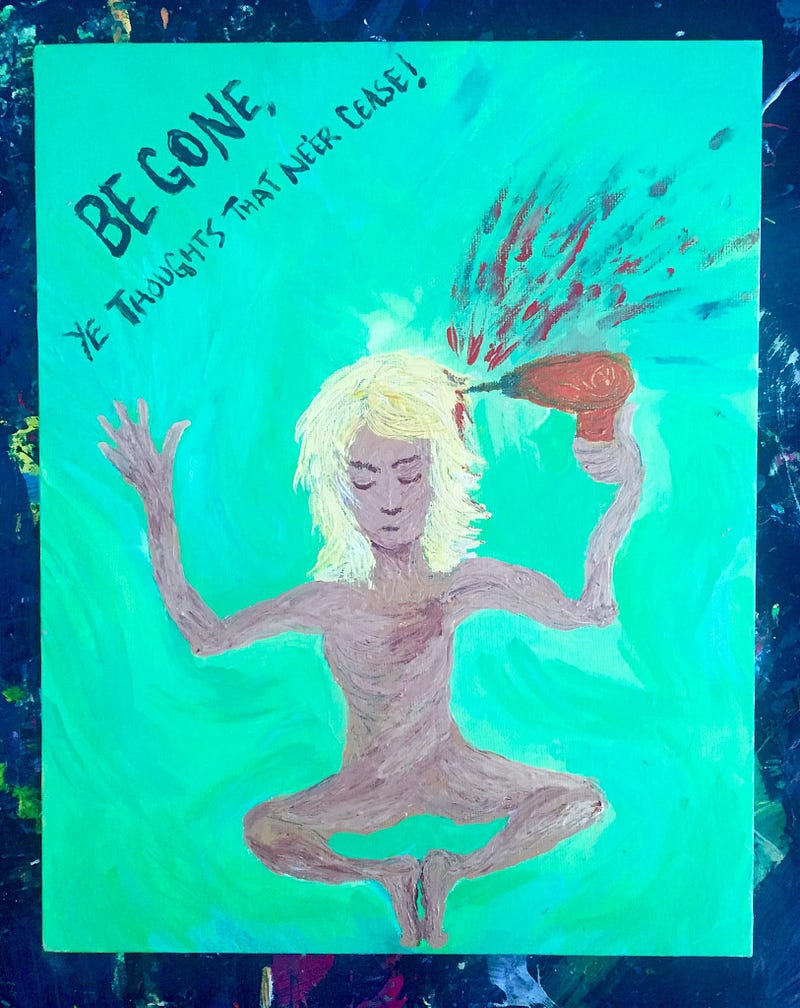
painting of drill to head

It’s hard for my brain to convince my brain not to figure things out. It’s been doing it for 30+ years now, it’s gotten quite good at it, and the skill has gotten it many places. In the competition to be the best neurons in my brain, the figure-it-out neurons have been winning for a long time.

But now I’m on to them. Now I’ve seen that they’ve taken control of my brain, and that they simply have too much control. I’ve got a plan. I’m drying them out. I can’t prevent the thoughts from starting up in my head, but I can prevent them from going on for many minutes. I can interrupt their flow.

My technique of choice: continuous chanting. It’s been a few months since I graduated from a 4 month Human Development Training retreat, and I’ve been chanting ever since, every day, all day, for as long as my roommates can take it. Sometimes that chanting turns into singing silly songs to myself; sometimes it turns into nonsense poetry. But the technique works just the same. You see, during that retreat, I discovered that my mind has multiple tracks. Even during continuous chanting, my mind can keep thoughts going on another track. But at least with chanting, those thoughts can’t go as far, since they don’t have as much time/space as before. There’s also increased awareness of how far they’ve gone, likely due to the cognitive overhead involved in keeping them going. Here, a technical diagram:

Some thought loops are very strong, trying to scream louder than the chant track. When that happens, it’s sometimes because a thought actually needs to be processed. I start with the most lightweight processing I can do, scribbling it on a piece of paper. If the thought still screams because it doesn’t think the paper’s good enough, I can write it down digitally. If it’s still persisting after that, then I talk over the thought with a friend. That’s often the first recourse in our society, but for me, it’s the last recourse, because talking things over can solidify thoughts more than necessary and it involves putting thoughts into other people’s heads, too.

There are other thought loops that don’t need processing; they just need a BIG interruption. These are my top 3 favorite ways of clearing my mind:

  • The Ursonate: A rhythmic nonsense poem. You can watch my favorite verse progression, or read my post about learning it.
  • Manjushri chant: A Tibetan mantra which can be chanted with an increasing tempo until it gets so fast that no thoughts can squeeze in. Usually a teacher leads it, but I also made a little web version for myself.
  • Kum Nye: A form of Tibetan Yoga with slow poses. Some of the poses bring up such intense bodily feelings that they clear my mind as well. You can learn Kum Nye from Nyingma Institute or a book.

To properly use my chant-the-thoughts-away techniques, I’ve found that I also need to avoid incompatible activities. Mostly, that means avoiding listening to music or watching concerts. I’ve found that I can’t chant while listening to someone else’s audio track, but I can still think (A LOT). Therefore, no music listening for me. That’s okay, I make my own!

Now you might be wondering: is it working? Are my thoughts drying out? Yes and no. I’m noticing much less unnecessary negative thoughts, like judgments about other people or about myself. I do still have many brainstorming thoughts, but they’re not as all-consuming as before.

I’ve noticed it’s particularly important that I employ these techniques after a happening, event or conversation. In the past, I’d often get in loops of rehashing and regret, which would turn an experience negative. Now, the experience is what it is, without one aspect of it being multiplied by my mind. It’s also important to dry thoughts out while I’m working on something I find difficult, as negative self-judgments can also easily multiply and get in the way of progress. It’s all about not letting the mind make a thought bigger than it needs to be, if it needs to be there at all.

My techniques are obviously very much inspired by having spent months on a Tibetan Buddhist retreat and experimenting with everything we learned there. But your mileage may vary. Also, your mind may work completely different from mine. Or you may not have any need for these techniques. Who knows? I do not know your mind. But I know mine much better now, and I’m going to try my best to retrain it.

Thursday, March 23, 2017

Learning the Ursonate: the mind-clearing benefits of non-conceptual sound poetry

In the last two weeks of a 4-month Tibetan Buddhist retreat, we were instructed to engage in “non-conceptual silence.”

I already knew how to engage in silence, as I had worn my “In Silence” badge many times earlier in the retreat. Non-conceptual silence was new to me. It meant no reading of the many Buddhist books I’d amassed or even my Kurt Vonnegut short stories collection. It meant no dance parties to pop songs. Literature and lyrics are chock full of concepts, and the challenge was to avoid engaging the mind in concepts unless absolutely necessary.

I still wanted a way to spend my breaks, some way to engage my mind. That’s when I remembered a 3-minute long animation called Primiti Too Taa, which illustrates a “sound poem” of made-up syllables. That animation had stuck with me since first watching it in college; I’d find myself looking it up once a year to watch again or share with a friend. There was something about the rhythmic nonsense sounds that resonated with me.

This time after re-watching the animation, I researched its source. The original poem is The Ursonate by German Dadist artist Kurt Schwitters, and it is an entire hour of made-up syllables spoken with rhythmic intonation.

And thus, I spent my breaks reciting that poem in my room. I listened to mp3 recordings while I followed along with a PDF of the text.

I loved how it engaged my mind fully while not miring it in concepts and judgments of how things are or should be in the world. I found myself reciting my favorite verses while doing other activities, and that allowed my body to enjoy those activities more. My mind is one that likes to fill itself with thoughts, and as those thoughts tend toward the critical/anxious side, they can take away from my bodily enjoyment of activities. By engaging it with the Ursonate, I make it harder for the negative thoughts to pop up.

Because I benefited so much from the Ursonate, I want to make it easier for other people to recite it. Using a text-audio sync-up tool, I’ve made video recordings of the entire Ursonate with each line bolded as Kurt recites it, and uploaded them to Youtube. You can watch the entire Ursonate, the 4 parts separately, or if you're short on time, my favorite progression of verses.

If you try it out, do let me know how it works for you. Everyone’s mind is different, and I’m curious if there are other minds out there that benefit from sound poetry.
(And hey, maybe one day, we’ll all get together and recite the Ursonate together in a room. Mind-clearing, engage!)

Monday, March 6, 2017

My Nightly Gratitude Journal

It can be hard to keep up any practice, especially at night when willpower is at an all-time low and the body wants to rest. I have found that when a practice is powerful enough, however, my mind and body can find a way.

I have now been keeping up a nightly gratitude journaling practice for more than 3 months — and I intend to continue it.

I first started the practice during Thanksgiving last year, after a seasonally themed gratitude class by Erika Rosenberg at the Nyingma Institute. Erika mentioned various studies where people’s positivity and general health increased while gratitude journaling, and recommended we try it ourselves. I’m a sucker for science-backed positivity boosts and for doing the extra credit in class, so I immediately started my own journal. I was also in the midst of a 4 month Buddhist retreat, so I had ample mental space to start practices and study their effects.

For my gratitude journal, I decided to focus on feeling grateful towards people rather than things, because I was also working on my tendency to negatively judge others. I figured that I could counter the negative judgments conjured up by my mind by purposefully conjuring up positive judgments as well. Anecdotally, it works!

Now, every night, I write “Today I’m grateful for”, number my lines 1–10, and in each spot I write “person X for doing action Y”. Admittedly, 10 is a high number for a gratitude journal, but I like forcing myself to dig deep to think of 10 interactions each day. And if it’s been a solitary day, I can always thank my cats for being playful. :)

To encourage friends and family to start a gratitude practice, I made them journals for Christmas by pasting the instructions below (PNG, PSD) on the inside cover of little notebooks.

As with any practice, I encourage you to experiment with the format and see what is most effective for you. I wish you well on your journey.

Instructions for gratitude journal

Tuesday, January 17, 2017

Operation Calm the Mind Down


A year ago I found myself wide awake at 5AM after a New Years party with my friends. I was still awake because my mind would not let my body go to sleep — it was convinced that things-were-not-OK and needed fixing, despite my friends all sleeping peacefully around me and the birds chirping outside.
Desperate to get to sleep, I researched insomnia and paranoia on the internet. I discovered a webpage about Generalized Anxiety Disorder and I read it with fascination — it described my mind to the tee, including the kind of physical activities I enjoyed (rock climbing, martial arts). I followed a 10-minute calming technique from that site called Progressive Relaxation, and I was soon asleep.

That’s when I truly realized that I was an anxious individual. Sure, I’d identified as “stressed out” or “worrywart” in the past, but I figured everyone would be in those situations. But when I could see my anxiety so large next to the calmness of those around me, I realized that my anxiety was something my mind was intent on having, despite it being unneeded.

For the past year, I’ve been studying my mind in detail — trying to understand all of its mental states, to see what techniques can change its mental state, and ultimately, to be able to avoid ever sinking into such a deep pit of anxiety again. 

This post is an overview of what I’ve tried, and how it’s worked for me. I am not a psychologist or a scientist. I encourage everyone to investigate their mind for themselves, and I hope my quest can give you ideas.


Getting Away From It All

Just after that New Years party, my partner and I spent a winter in the woods. We had already planned the trip, with the goal of seeing how different the world and our selves could be. We learned a lot, but as I detailed in my post on the trip, I found out that my mind could even become anxious during walks along the beach. It was at that point that I actually started an “Operation Calm the Mind Down” spreadsheet — I was determined to figure out my anxiety once and for all, gosh darn it. 

Compassion Meditation

When we got back to SF, I immediately signed up for the Stanford Compassion Cultivation Training course, an 8-week class inspired by Buddhist teachings on compassion for yourself and others. Our only homework was to meditate each day, using a different meditation mp3 each week. At first, I was only meditating every few days, as it felt like a chore that wasn’t producing anything for me. 
But then our third week was a self-compassion meditation, and whoah, I could see the effect of those sessions! From then on, I meditated nearly every day. Somehow, the self-compassion script could kick me out of my fast-paced analytical mind into a slower nurturing mind, and affected my approach to the world that day. I didn’t suddenly walk around as a Zen monk, but I could feel my edges soften.

I’ve recorded a version of that self-compassion meditation here, if you’d like to try it for yourself. I also recommend reading Tara Brach’s Radical Acceptance and Thupten Jinpa’s Fearless Heart for more on compassion.

Of course, that meditation may not do the same for you. That’s why I encourage would-be meditators to explore the hundreds of meditation scripts and styles out there. Find out if there’s one that’s Just Right™.

Flotation Tank

A flotation tank, or sensory deprivation tank, is a coffin-like structure with gallons of heavy salt water inside it. Once you go inside, you turn the lights off and float for an hour or two. They are now popular enough that you can find them in cities, like Reboot in SF.

As it turns out, I adore being inside a flotation tank (and my fear of the dark doesn’t follow me in!). I often feel significantly calmer after — and I can see the proof of that in how okay I am with simply wandering around the nearby parks and not rushing off to get back home. 

If I had infinite time and money, I might start every day off with a flotation tank session. However, I don’t, so I only go every few weeks or when I feel a particular need for it.

If you’ve never tried it and you have the resources to make it happen, try it out and see what effect it has on you. And then perhaps in the great big beautiful tomorrow, startup offices will all have built-in flotation tanks. :) 

Acupuncture

I’ve always been a very Western medicine kind of girl. But, in the quest to calm the mind, I didn’t want to leave any stones unturned. Especially stones that are down the street and oft-recommended.

So I went to SF Community Acupuncture and asked for treatment focused on anxiety. While I sat there with the needles in, I did various breathing meditations like counting to 10 and feeling the heart. (If I didn’t, then my thoughts would wander, and they’d likely wander into anxious territory… can’t have that!) I enjoyed the session and felt more relaxed after.

For me, acupuncture didn’t have as much of an effect as the flotation tank and has a similar price point, so I opted not to go back for a second session.

Kirtan (Chanting)

Kirtan is a style of call-and-response chanting from the Hindu tradition. As it’s done here, it’s often a circle of people with a few drums and shakers, and they’ll all follow a chant leader. The chanting is melodic and changes tempo, getting faster and slower.

A friend suggested it to me, and I checked it out one morning at Laughing Lotus SF. When we first started chanting, I found myself distracted by worries about getting the words right. But then, the chanting got so fast that my mind didn’t have a space to worry, and poof, the worries were gone! I felt amazing afterward, almost high — and I found myself being sociable with strangers, a sure sign of an improved mental state.

From then on, I became a regular at each Tuesday/Thursday kirtan session, and I eagerly looked forward to the moments that the chanting would go so fast that it’d kick my anxious thoughts out. (So, yes, I do tend to get a bit anxious waiting for that moment… funny mind!)

Biofeedback Therapy

At this point, I had discovered various techniques to semi-reliably transform my mental state for a few hours up to a day. But I didn’t want to be dependent on flotation tanks and kirtan groups. I wanted a more permanent mental change.

It was time to bring in the big guns: therapy… biofeedback therapy! I had heard of it once, found one doctor locally who did it, and decided to try one session. First we talked like regular old therapist-client, so he could find out my concerns and goals. 

Then, the fun part: he stuck electrodes on my head. The electrodes monitored my brain waves, which got displayed on a screen in front of me, divided into moving graphs of Alpha, Beta, and Theta waves. The waves were then turned into sound — something like an ocean/organ remix — which I listened to with headphones. Then I would hear beeps whenever my Beta and Theta waves went above a certain level. The Alpha waves are more associated with calmness, and Beta more with thoughts, so our goal was for me to be able to raise my Alpha and lower my Beta. For around 30 minutes, I sat there with my eyes closed, listening to the sound of my brain, and noticing the beeps when my brain went higher into thought-y territory. (I’m not a neuroscientist, apologies for inaccuracies/oversimplifications here.)

After that first session, I felt calm, more able to take my time with things. I decided to go for another 12 sessions to see what my mind would learn from the Alpha wave training. It was a mind-opening experience which I could write much more about, but here were my main take-aways:
  1. I often experienced a nice after-glow from the sessions — similar to the effect of the flotation tank. That after-calmness could last the whole day, or just a few minutes, depending on the happenings of the day.
  2. I started experiencing moments of “no thought”, where my mind would blank while walking around. I had only a few of those moments, but they were lovely enough that they stuck with me.
  3. Most importantly: I identified less with my emotions than before. Since I now had the experience of actually watching my mind, I could more easily step back in real life situations and observe my mind as a non-judgmental casual observer. That allowed me to let go of my mind’s reactions more easily.
Anxiety Tracking

Once I started the biofeedback therapy, I started tracking my mental state even more rigorously. I wanted to be able to report to the therapist how the week actually went, and not just base it on the last hour of data. I experimented with various trackers focused on mental health, but then I simply downloaded Grid Diary and I set up a square each day for “When was I anxious today?” and “When was I calm today?”.

That tracking helped me become much more aware of my own triggers and motivated me to address nagging issues that were burdening my mind. 

Tibetan Buddhist Retreat

During the last few weeks of my biofeedback therapy, I started reading a Buddhist-inspired e-book, Meaningness. Buddhism has many teachings on non-reactivity and on realizing the nebulosity of the self, and those teachings complemented my biofeedback realizations beautifully. Those teachings gave me even more permission to let go of my attachment to my self and to my anxiety.

I saw how my mind was helped by the Buddhist-inspired self-compassion meditation and I wanted to know if going further into Buddhism would help me even more. 

So, like a good investigator girl, I went into Buddhism for 4 months. 

Specifically, I spent my fall at the Nyingma Institute of Tibetan Buddhism in a program called the Human Development Training retreat. We’d spend each day in sessions of Tibetan-style meditations, Kum Nye (Tibetan Yoga), and inquiries into the nature of self. We also had “work practice” each day, where we’d do house chores while observing our mind. 

It was an incredible experience, and I hope to write so much about it in the future. But for now, what I will say is that:
  1. I came to realize how my anxiety often manifests as excited planning, and to truly recognize the negative consequences of such a seemingly positive mental state.
  2. I now have a giant toolbox of techniques that I can use to calm my mind, and they are all techniques that require only my mind and body to execute — such as different mantras that can balance my mind and meditations to transform negative emotions.
  3. I believe my mind is more permanently changed now. I wake up feeling much calmer now, before I even employ any of those techniques. I can take on difficult situations that used to scare me. But I know that the mind is prone to falling back into its habits of self, so I am currently going through life at a very slow pace.
My mind has spent 3 decades learning how to be anxious — it’s very good at it. So I will continue this journey with a vigilant yet delicate watch.

May you all fare well on your own journeys into the mind.


Tuesday, January 10, 2017

Project IceBreak: Let’s make networking easier

I’ve attended over 100 tech conferences —  and spoken at most of them.

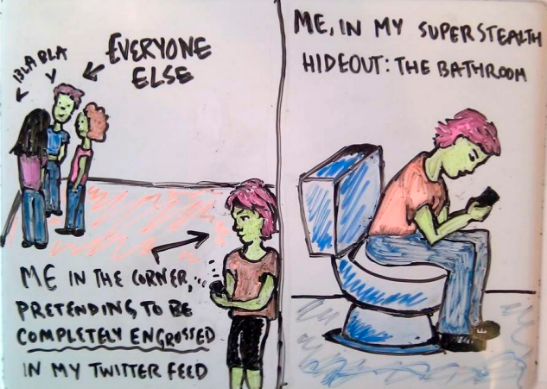
And yet, despite my many hours of practice surrounding myself with seas of strangers, I've often found myself hiding during the “social” times of many of those conferences. I hide in the bathroom during the networking hour, I hide in the bushes to eat my lunch, I hide in the hotel to avoid the after-parties. I even illustrated that in my "No, Really, I'm Shy" Ignite talk:

I love speaking to crowds, but as soon as I find myself actually in the crowd, faced with the threat of casual conversation, I get nervous. I worry about who to approach, what to say to them, and how to stop talking to them eventually.

I think its due to my social anxiety that I put extra effort into the social aspects of the events that I organize--because I don’t want to put others in the same situations that I dread. I am now actively working to be less socially anxious, but in the meantime, I want socializing to be easier for everyone.

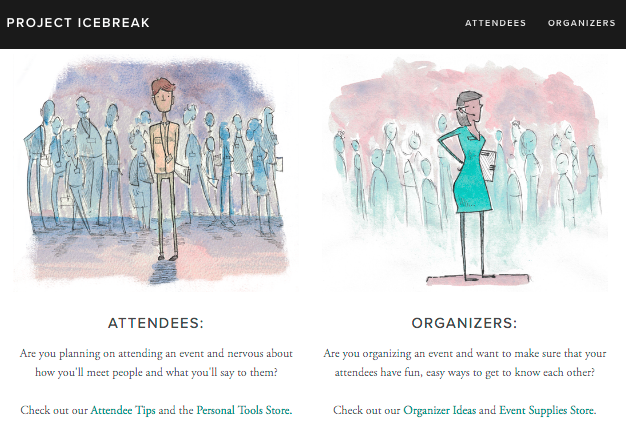
That’s why I’ve put together a website called Project IceBreak. It’s a collection of tips for attendees and ideas for organizers that I’ve been blogging over the years, plus an Etsy store with a few supplies.

The website has sections both for attendees and organizers, but the meat of it is about what you can do as an organizing- because there are a lot of ways you can give your attendees more ways to connect. That might sound intimidating, but here’s the thing: sometimes it takes just one tweak to an event to make it easier to meet people. For example, every speaker can start off their talk with “Now introduce yourself to the person next to you and tell them one thing you learned today.” That’s already one new guaranteed connection per talk for all your attendees!

So please, share this site with any event organizers that you know. Networking can — and should — be easier. Thank you!

Wednesday, August 17, 2016

Learning new skills in SF


I had lunch with an old colleague the other day. She was excited to tell me that she’d been inspired by my extracurriculars — the classes I was taking outside of work — and finally started learning singing. She had never thought of learning new skills as an adult before.

I’m here to tell you that, yes, you can learn new things as an adult, and yes, it’s awesome. Sometimes it’s a welcome break from your day job, sometimes it relates in unexpected ways to it, and sometimes it becomes your next job! Here’s a roundup of the new skills I’ve learned in SF:


There’s so much more you can learn in SF, of course — this is just to get you thinking about what you might learn and where. To find a class for whatever you’re interested in, I suggest starting with SF Rec (they’re subsidized, so they’re cheapest), then search Yelp and Google. You can also look at the online catalogs for local community colleges, usually quite affordable.

You can then try to find a friend interested in taking the class with you. Email any that are top of mind, or broadcast your intent on FB. Taking a class with someone is a great opportunity to bond — you’ll both get to fail in front of each other, get those vulnerable juices going! A caveat: if your friend isn’t a “Hell, yes!” about the class, don’t push them to register—in my experience, they’ll probably drop out, or you’ll spend the time worried about their enjoyment.

I’m actually posting this on the day that I start a 4 month Buddhism retreat at the Nyingma Institute. I took a 3 day workshop there a month ago and now I’ve decided to go deep. You never know where a class will take you! :)

Thursday, December 24, 2015

My "touchy-feely" takeaways

I recently took the weekend version of Stanford's "touchy feely class", COM 19. I had heard good/intriguing things about it from my colleagues, and in the spirit of trying anything communication-related once, my partner and I signed up.

The class revolves around this thing called a "T group", which is a group of 12 strangers sitting in a circle for hours, staring at each other, and talking only about things actually happening there and then. What do strangers have to talk about? A lot, as it turns out. We all feel and think things when we're in new situations, and we tried to express those honest feelings while in the circle (thanks to the help of a feelings vocab sheet in our laps).

Before and during the process, we come up with our personal learning goals, and we discuss those with our coaching group. These were mine:

  • I often resort to humor in tense situations. I wanted to be able to recognize the emotions behind that humor and express those instead.
  • I tend to avoid conflict, and if there is conflict, my instinct is to run and hide. My goal was to not run into the bathroom, metaphorical or actual.
  • I rush to judgment of others and am quick to point out the ways they're violating the rules. That's been a goal for me generally in life this year, so I made it a goal for T group.
  • I realized during the class that I didn't handle it well when another person expressed appreciation for me (I deflected or tried to hide), so I made a goal of learning to receive appreciation.
  • Similarly, I realized I wasn't giving as much appreciation as others, so I made it a goal to practice giving appreciation.

I definitely felt like I progressed in my goals, some more than others. I did find myself getting into "teacher mode" a lot, which often happens in classroom-like situations, and I wasn't as emotionally engaged in that teacher mode. I did take an awful lot of notes about the ways that facilitators worded things, though. Here are a few of my favorite phrasings:

Describing our feelings/needs:
  • “I noticed… I feel… Pause.”
  • “The story that I tell myself is…”
  • “My experience of you…”
  • “My wish for you….”
Discovering how others feel:
  • “I’m sensing that you… Is that right?”
  • “I’m hearing that you…”
  • “How did my feedback land with you?”
  • “How do you feel right now?”
  • “How did it feel when I said that?”
  • “Can I check in with you to see how you’re feeling?”
  • “Do you feel complete with our conversation?”
Responding to conflicts:
  • “It’s not about the mess, it’s about cleaning it up. Let’s celebrate it!”
  • “I see that she is trying to make a repair, and I want to recognize that.”
  • “I see that you’re going into a shamehole, and my wish for you is to not go there.”

I found it particularly helpful that my partner and I both signed up. They put partners in separate groups, so that we can get touchy-feely without the baggage of a relationship. However, we met up during meals, exchanged notes, and often challenged each other to go further in our learning goals. After the workshop, we were able to communicate better because we were both so used to expressing feelings, and we expected that of each other.

I recommend checking out the class if you're interested in communication and honest expression. It will likely be a very different experience for you than for me, but it will certainly be an experience either way!