Showing posts with label socialanxiety. Show all posts

Tuesday, January 17, 2017

Operation Calm the Mind Down


A year ago I found myself wide awake at 5AM after a New Years party with my friends. I was still awake because my mind would not let my body go to sleep — it was convinced that things-were-not-OK and needed fixing, despite my friends all sleeping peacefully around me and the birds chirping outside.

Desperate to get to sleep, I researched insomnia and paranoia on the internet. I discovered a webpage about Generalized Anxiety Disorder and I read it with fascination — it described my mind to the tee, including the kind of physical activities I enjoyed (rock climbing, martial arts). I followed a 10-minute calming technique from that site called Progressive Relaxation, and I was soon asleep.

That’s when I truly realized that I was an anxious individual. Sure, I’d identified as “stressed out” or “worrywart” in the past, but I figured everyone would be in those situations. But when I could see my anxiety so large next to the calmness of those around me, I realized that my anxiety was something my mind was intent on having, despite it being unneeded.

For the past year, I’ve been studying my mind in detail — trying to understand all of its mental states, to see what techniques can change its mental state, and ultimately, to be able to avoid ever sinking into such a deep pit of anxiety again. 

This post is an overview of what I’ve tried, and how it’s worked for me. I am not a psychologist or a scientist. I encourage everyone to investigate their mind for themselves, and I hope my quest can give you ideas.


Getting Away From It All

Just after that New Years party, my partner and I spent a winter in the woods. We had already planned the trip, with the goal of seeing how different the world and our selves could be. We learned a lot, but as I detailed in my post on the trip, I found out that my mind could even become anxious during walks along the beach. It was at that point that I actually started an “Operation Calm the Mind Down” spreadsheet — I was determined to figure out my anxiety once and for all, gosh darn it. 

Compassion Meditation

When we got back to SF, I immediately signed up for the Stanford Compassion Cultivation Training course, an 8-week class inspired by Buddhist teachings on compassion for yourself and others. Our only homework was to meditate each day, using a different meditation mp3 each week. At first, I was only meditating every few days, as it felt like a chore that wasn’t producing anything for me. 
But then our third week was a self-compassion meditation, and whoah, I could see the effect of those sessions! From then on, I meditated nearly every day. Somehow, the self-compassion script could kick me out of my fast-paced analytical mind into a slower nurturing mind, and affected my approach to the world that day. I didn’t suddenly walk around as a Zen monk, but I could feel my edges soften.

I’ve recorded a version of that self-compassion meditation here, if you’d like to try it for yourself. I also recommend reading Tara Brach’s Radical Acceptance and Thupten Jinpa’s Fearless Heart for more on compassion.

Of course, that meditation may not do the same for you. That’s why I encourage would-be meditators to explore the hundreds of meditation scripts and styles out there. Find out if there’s one that’s Just Right™.

Flotation Tank

A flotation tank, or sensory deprivation tank, is a coffin-like structure with gallons of heavy salt water inside it. Once you go inside, you turn the lights off and float for an hour or two. They are now popular enough that you can find them in cities, like Reboot in SF.

As it turns out, I adore being inside a flotation tank (and my fear of the dark doesn’t follow me in!). I often feel significantly calmer after — and I can see the proof of that in how okay I am with simply wandering around the nearby parks and not rushing off to get back home. 

If I had infinite time and money, I might start every day off with a flotation tank session. However, I don’t, so I only go every few weeks or when I feel a particular need for it.

If you’ve never tried it and you have the resources to make it happen, try it out and see what effect it has on you. And then perhaps in the great big beautiful tomorrow, startup offices will all have built-in flotation tanks. :) 

Acupuncture

I’ve always been a very Western medicine kind of girl. But, in the quest to calm the mind, I didn’t want to leave any stones unturned. Especially stones that are down the street and oft-recommended.

So I went to SF Community Acupuncture and asked for treatment focused on anxiety. While I sat there with the needles in, I did various breathing meditations like counting to 10 and feeling the heart. (If I didn’t, then my thoughts would wander, and they’d likely wander into anxious territory… can’t have that!) I enjoyed the session and felt more relaxed after.

For me, acupuncture didn’t have as much of an effect as the flotation tank and has a similar price point, so I opted not to go back for a second session.

Kirtan (Chanting)

Kirtan is a style of call-and-response chanting from the Hindu tradition. As it’s done here, it’s often a circle of people with a few drums and shakers, and they’ll all follow a chant leader. The chanting is melodic and changes tempo, getting faster and slower.

A friend suggested it to me, and I checked it out one morning at Laughing Lotus SF. When we first started chanting, I found myself distracted by worries about getting the words right. But then, the chanting got so fast that my mind didn’t have a space to worry, and poof, the worries were gone! I felt amazing afterward, almost high — and I found myself being sociable with strangers, a sure sign of an improved mental state.

From then on, I became a regular at each Tuesday/Thursday kirtan session, and I eagerly looked forward to the moments that the chanting would go so fast that it’d kick my anxious thoughts out. (So, yes, I do tend to get a bit anxious waiting for that moment… funny mind!)

Biofeedback Therapy

At this point, I had discovered various techniques to semi-reliably transform my mental state for a few hours up to a day. But I didn’t want to be dependent on flotation tanks and kirtan groups. I wanted a more permanent mental change.

It was time to bring in the big guns: therapy… biofeedback therapy! I had heard of it once, found one doctor locally who did it, and decided to try one session. First we talked like regular old therapist-client, so he could find out my concerns and goals. 

Then, the fun part: he stuck electrodes on my head. The electrodes monitored my brain waves, which got displayed on a screen in front of me, divided into moving graphs of Alpha, Beta, and Theta waves. The waves were then turned into sound — something like an ocean/organ remix — which I listened to with headphones. Then I would hear beeps whenever my Beta and Theta waves went above a certain level. The Alpha waves are more associated with calmness, and Beta more with thoughts, so our goal was for me to be able to raise my Alpha and lower my Beta. For around 30 minutes, I sat there with my eyes closed, listening to the sound of my brain, and noticing the beeps when my brain went higher into thought-y territory. (I’m not a neuroscientist, apologies for inaccuracies/oversimplifications here.)

After that first session, I felt calm, more able to take my time with things. I decided to go for another 12 sessions to see what my mind would learn from the Alpha wave training. It was a mind-opening experience which I could write much more about, but here were my main take-aways:
  1. I often experienced a nice after-glow from the sessions — similar to the effect of the flotation tank. That after-calmness could last the whole day, or just a few minutes, depending on the happenings of the day.
  2. I started experiencing moments of “no thought”, where my mind would blank while walking around. I had only a few of those moments, but they were lovely enough that they stuck with me.
  3. Most importantly: I identified less with my emotions than before. Since I now had the experience of actually watching my mind, I could more easily step back in real life situations and observe my mind as a non-judgmental casual observer. That allowed me to let go of my mind’s reactions more easily.
Anxiety Tracking

Once I started the biofeedback therapy, I started tracking my mental state even more rigorously. I wanted to be able to report to the therapist how the week actually went, and not just base it on the last hour of data. I experimented with various trackers focused on mental health, but then I simply downloaded Grid Diary and I set up a square each day for “When was I anxious today?” and “When was I calm today?”.

That tracking helped me become much more aware of my own triggers and motivated me to address nagging issues that were burdening my mind. 

Tibetan Buddhist Retreat

During the last few weeks of my biofeedback therapy, I started reading a Buddhist-inspired e-book, Meaningness. Buddhism has many teachings on non-reactivity and on realizing the nebulosity of the self, and those teachings complemented my biofeedback realizations beautifully. Those teachings gave me even more permission to let go of my attachment to my self and to my anxiety.

I saw how my mind was helped by the Buddhist-inspired self-compassion meditation and I wanted to know if going further into Buddhism would help me even more. 

So, like a good investigator girl, I went into Buddhism for 4 months. 

Specifically, I spent my fall at the Nyingma Institute of Tibetan Buddhism in a program called the Human Development Training retreat. We’d spend each day in sessions of Tibetan-style meditations, Kum Nye (Tibetan Yoga), and inquiries into the nature of self. We also had “work practice” each day, where we’d do house chores while observing our mind. 

It was an incredible experience, and I hope to write so much about it in the future. But for now, what I will say is that:
  1. I came to realize how my anxiety often manifests as excited planning, and to truly recognize the negative consequences of such a seemingly positive mental state.
  2. I now have a giant toolbox of techniques that I can use to calm my mind, and they are all techniques that require only my mind and body to execute — such as different mantras that can balance my mind and meditations to transform negative emotions.
  3. I believe my mind is more permanently changed now. I wake up feeling much calmer now, before I even employ any of those techniques. I can take on difficult situations that used to scare me. But I know that the mind is prone to falling back into its habits of self, so I am currently going through life at a very slow pace.
My mind has spent 3 decades learning how to be anxious — it’s very good at it. So I will continue this journey with a vigilant yet delicate watch.

May you all fare well on your own journeys into the mind.

Tuesday, January 10, 2017

Project IceBreak: Let’s make networking easier

I’ve attended over 100 tech conferences —  and spoken at most of them.

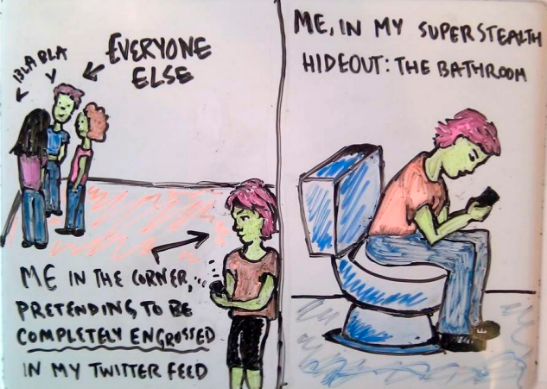
And yet, despite my many hours of practice surrounding myself with seas of strangers, I've often found myself hiding during the “social” times of many of those conferences. I hide in the bathroom during the networking hour, I hide in the bushes to eat my lunch, I hide in the hotel to avoid the after-parties. I even illustrated that in my "No, Really, I'm Shy" Ignite talk:

I love speaking to crowds, but as soon as I find myself actually in the crowd, faced with the threat of casual conversation, I get nervous. I worry about who to approach, what to say to them, and how to stop talking to them eventually.

I think its due to my social anxiety that I put extra effort into the social aspects of the events that I organize--because I don’t want to put others in the same situations that I dread. I am now actively working to be less socially anxious, but in the meantime, I want socializing to be easier for everyone.

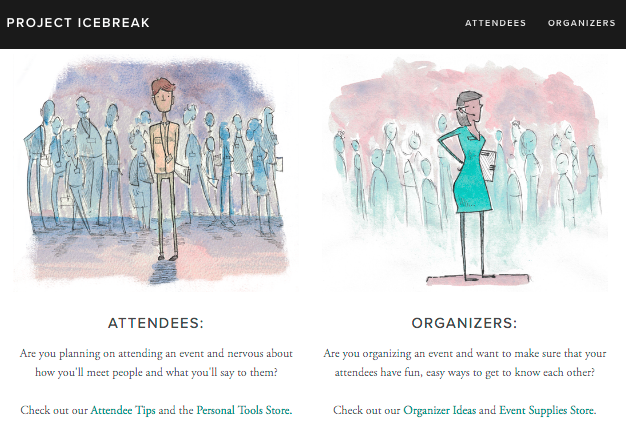
That’s why I’ve put together a website called Project IceBreak. It’s a collection of tips for attendees and ideas for organizers that I’ve been blogging over the years, plus an Etsy store with a few supplies.

The website has sections both for attendees and organizers, but the meat of it is about what you can do as an organizing- because there are a lot of ways you can give your attendees more ways to connect. That might sound intimidating, but here’s the thing: sometimes it takes just one tweak to an event to make it easier to meet people. For example, every speaker can start off their talk with “Now introduce yourself to the person next to you and tell them one thing you learned today.” That’s already one new guaranteed connection per talk for all your attendees!

So please, share this site with any event organizers that you know. Networking can — and should — be easier. Thank you!

Thursday, June 11, 2015

I don't always have to be The Entertainer

"The Entertainer came out tonight."

That's what my partner told me a few times, after dinners with old friends of mine. He says he doesn't quite recognize "The Entertainer", that it's not the version of me that he's grown to know over our past 8 months together, and that he's bothered by some of my behavior in that version of myself.

It took me a while to figure out who this Entertainer was, and why it might be bothersome, but I think I've got it now.

As a kid, I determined pretty early on that the way to get friends was to impress people. I remember coming up with party tricks for the cafeteria lunch table in elementary school (I would offer to eat everyone's brown paper lunch bags and rate their deliciousness). I remember offering my house T1 line to potential house-comer-overs in middle school (back when home internet connections weren't a thing). I remember bringing bags full of candy and toys to school for *every* holiday, offering them to every one of my classmates.

...And it worked! Well, at least, it did superficially. I always had full birthday parties, I always had a place to sit at lunch, I always won our class presidency elections. But now that I look back, and realize how few "friends" I kept in touch with since then, I wonder if it really worked? Was I actually friends with all those people? Did I actually even know anything about all those people? What if I just spent my childhood entertaining them, and never remembered to have a real conversation with them?

It's hard for me to really say because my memory is so poor to begin with, but I *can* evaluate my current life and how I'm relating to the people around me. I've realized that I know very little about most of my Khan Academy and GDI colleagues, and anything I do know was information they proactively shared. I suspect I resort to being "The Entertainer" around them, like at the lunch table, because that's the way I've learned to relate to the world.

But why? Why do I feel such a strong urge to entertain? Like most of the things I'm discovering about myself lately, it seems to be a social anxiety that comes from a fear of unworthiness. I think I'm afraid that if I don't entertain, then I haven't earned my place at the table. If I do, then I've proven myself worthy of love and attention - even if it's only a particular version of myself, even if it means most of my connections are devoid of true 2-way interactions.

I've decided that I don't always have to be The Entertainer anymore. I can be the Listener -- the Curious Cat -- the Eager Participant -- the Smile&Nodder -- a self that is comfortable with my place at the table. I don't think its going to be particularly easy for me to become a Listener; I don't have a whole lot of practice. I seem to be able to become a Listener in the presence of my partner, for whatever reason, so I'm going to try to call on that self when I'm not around him.

I will be happier in the long-run if I can become comfortable with not being The Entertainer. I want to relate to people in a way that isn't fueled by my fear of unworthiness, but fueled by a genuine desire to connect more deeply with them.

Tuesday, June 9, 2015

Why am I so afraid of mingling?

I was at a meetup tonight, and after a round of introductions, the host said "and now we'll mingle before the talk!" At that point, I literally hid in the bathroom. I waited there until the sounds of mingling died down, and I knew it was safe to rejoin and watch the talk. This wasn't the first time I've hidden in the bathroom during the mingling part of a meetup. It wasn't even the second or third time. Bathrooms and me, we're old friends.

So why am I afraid of mingling? Let's break it down:

  • Fear of the approach: I have to pick somebody to go up to, and hope they also wanted me to approach, or are okay with me approaching them. I have to tell myself that they're not going to groan to themselves "ugh, I didn't want them to approach!" I know that, rationally, I shouldn't feel so unworthy of their desire to speak with me, but emotionally, I have that tendency. I am working through that, in therapy and a Radical Acceptance reading club with my partner, but I'm not to the point yet where I can think to myself, "sure, anyone would love to talk to me!" and wholeheartedly believe it.
  • Uncertainty on the topic: Assuming I manage to approach someone, I then have to figure out the right conversation topic. At the meetup, the introductions included a "Ask me about ___" prompt and a "One time, I built ___ " prompt, designed to give us topics to talk about. Because of that, I think I could have approached a few people with a topic that I knew was relevant to my interests, and I'm thankful they provided that fodder for us. I also heard a nice prompt suggested tonight as a general conversation starter, "What's something you've learned recently?" I'd like to try that out, at meetups that don't provide any introduction fodder.
  • Fear of the finish: I have yet to figure out a good way to wind down a topic and leave it on a positive note. Instead, my 1-on-1 conversations often feel like they wither and die a slow, agonizing death. I've gotten suggestions like claiming you have to go to the bathroom, but I don't know that I'm a good enough liar for that, and that I can reasonably use that for every conversation. That's why I much prefer time-bucketed conversations or group conversations that allow for easy in-out transitions.

I know that my anxieties around mingling are fears that I need to work through, as they're tied to my underlying social anxieties in life. But I also believe that events can make networking less intimidating for those of us with these anxieties, and that's why I'm a big fan of more structured mingling. For example, at this meetup, they could have blown a whistle at the end of 4 minutes, and forced everyone to mingle with a new person, and that would have helped with my fear of approach and finish.

I wrote up more about making networking easier in this earlier post, and I think that the pre-matched speed networking is still my favorite of all the structured mingling attempts I've experienced. I hope more events experiment with that. Just in case I'm not the only one that hides in bathrooms. :)

Thursday, April 23, 2015

Towards more "Yes, and"s and less "but"s

Today we had a little Improv 101 workshop at Khan Academy, led by our colleague Kitt Hirasaki. I'm interested in improv both because I find it incredibly fun and stimulating, and also because I'm interested in the way it can help me improve the way I deal with every day life.

One of the great games we played was "Yes, and." In that game, two people go up and the first person starts off with a line of dialogue that hopefully sets out some aspects of the characters, their relationship, and the setting. The next person continues the dialogue, and regardless of what they say after, they must start their line with "Yes, and". This goes back and forth, continuing the scene, until it comes to a logical conclusion.

The idea behind that "yes, and" is to force the characters to fully embrace the reality introduced by the other character, and to build on it. They might still disagree on something in the scene, but they agree on the reality of the world they live in, and that makes it more believable for themselves and the audience. It makes the game collaborative instead of combative, and just feel more positive overall.

Since it promotes creativity and collaborative, the "yes, and" game has since been picked up by entrepreneurs and life coaches as a tool for businesses and organizations, and I just found there's an entire book named "Yes, and".

But back to me and my reality.

After the improv workshop, I went out to dinner with my partner. We were talking about something we weren't fully in agreement on, and happened to fall into the "yes, and" game, which made it feel more collaborative. We couldn't keep that up for long and it turned back into our usual dialogue style, and that's when I started noticing something: I start an awful lot of responses with "But." I haven't done a statistic analysis, but it felt like way more than the average response should start with.

Why? Probably because starting with "but" proves that I've found the hole in someone's statement -- which proves that I was smart enough to find that hole -- which proves that I'm worthy of love and admiration. I'm reading Radical Acceptance right now, which is helping me realize that much of my behavior is me trying to prove my worthiness, instead of me participating wholeheartedly in things I enjoy.

I would like to participate more, to collaborate more, to create more. Tomorrow, I'll try starting less of my responses with "But"; and perhaps even start them with "Yes, and." That may not be the game that gets me to change my worth-proving ways, but it's a start.


Thursday, February 27, 2014

The Long Lunch Table

For the last two years, I've had the pleasure of working for companies that are still small enough to fit in a room; small enough so that everyone can squeeze at the same lunch table. Even at Khan Academy, where we now have almost 50 people in the office, we have a long table made up of many tables, squished together so as to appear a continuous structure. I never really thought about that until today, when we were talking about plans for our new office.

You see, our small company is getting bigger, and we're moving into a larger space. We have to decide which of the traditions and configurations to bring over from our current space, and which to leave behind as a thing-we-did-when-we-were-smaller. One of those is the team lunch. Our office admin announced to all of us that they're working hard to make sure that we can continue to all eat lunch together. A devil's advocate amongst us responded with "Why? Why do we need to eat lunch at the same time and same table if we can only hear a 4 person radius around us?" He had a good point, yet he also provoked a visible gut reaction in many. But, why? What reasons did we come up with?

We kerfuffled for a bit, trying to justify our insanity on holding onto our irrational needs, until my colleague spoke up. He told the story of lunch at his last company, which was a few times larger. They had a long lunch period, with many small lunch tables in a big cafeteria, and employees were expected to lunch at different times, to distribute the lines over time. Employees would walk in, look around at the lunch tables, not see anyone they knew - or not see anyone they felt confident in table-crashing - and go back to their desks. Eventually, many of them defaulted to eating lunch at their desks. Lunch had gone from being a social affair to being a daily reminder of loneliness.

In fact, when he recalled this, I remembered feeling the same way at Google. Sure, I would know people scattered around the tables in the cafeteria, but it took guts to feel like I could impose myself on any given table. There were days that I couldn't muster up enough of those guts; and those were the saddest.

And now, finally, I realize the simple brilliance of the long lunch table and the single lunch period. When you get your food, you don't have to gather the confidence to approach a table - you just look at the long table, pick the next logical available seat, and sit there. That's what everybody does, and there's no expectation that you have to ask to do that, because, what else would you do?

Maybe the long lunch table is why I look forward so much to lunch every day at Khan Academy. It's certainly not that I dislike my work, but I adore our lunches: I don't have to stress about where to sit, and I know that wherever I sit, I'll be surrounded by some subset of my smart and funny colleagues.

Here's to hoping that we can keep our lunch table long for as long as possible.

Saturday, January 25, 2014

Networking at events: It should be easy, not scary

I was at an event the other night and the MC said, "I hope you like networking, because that's what we're here for!" My immediate thought was "Uhhhhhh, no. Networking is the most frightening thing I could ever imagine."

See, when I think about "networking," I picture a room full of people that have to come up with excuses to talk to each other, come up with excuses to stop talking to each other when the conversation has peaked, and keep doing this for hours on end. I can't decide which aspect of that is the worst, because it's all the worst. There are good parts in the middle, when you've discovered your commonality with your current conversational target and you figure out how you can both benefit from learning about each other, but those good parts are sandwiched by anxiety-inducing awkward social situations.

Fortunately, I'm not the only one who finds it hard to approach large numbers of random strangers, and I've been happy to come across multiple forms of more structured networking at recent events. I wanted to highlight a few of them here in this post, to put out ideas for the event organizers out there, and to hopefully find out about other approaches in the comments.

Introductions

I went to an EdSurge Womens Night last fall, and when I walked into the room full of people that I didn't know, much of them in the thick of conversations, I had a shyness attack. I immediately found a corner that wasn't visible from the rest of the room, and busied myself with my phone. And yes, I may have tweet-ranted my feelings a bit, as well. Once I get shy like that, I find it increasingly hard to recover, to muster up the courage to impose myself on someone - so I was ready to call it a failed night and go home.

But then the organizer shushed everyone, gave a little spiel about the event purpose and sponsors, and then encouraged us to give little spiels. She wanted us to let everyone know what we were there for - like if we were looking to hire, looking for a job, looking for partners. She didn't make everyone do it (which would have taken a while) but was encouraging enough that about a third of us took the mic for thirty seconds. I was one of those that gave a spiel, because I knew that I'm the kind of person that needs other people to approach me, especially in the shy state I was in then. After that, we all went back to mingling, but now we all knew a lot more about people that were there and had real reasons to approach each other. I was then busy the entire rest of the night, speaking with a variety of people who were interested in hearing more about what I was up to.

This will not work for every event, due to the time it takes -- but if the event is small enough, a simple round of introductions can do wonders for improving networking at events, for lowering the barrier to approach. There's still the problem of the social awkwardness of leaving a conversation, though, which is where the next strategies come in.

Speed Networking, Pre-Matched

Early this year, I attended an NSF conference for ~300 computer science education researchers. I'm new to the more academic circles, after being so heavy in the "industry" circles for so long, so I knew only a handful of the researchers. It was great getting to catch up with them, but I also wanted to meet a few new folks.

Thankfully, the conference organizers really wanted this gathering to be heavy on connecting and conversing with each other, starting with an unconference style approach to picking session topics and carving out time for 5 attendee-led discussion sessions.

On the first day, they announced a special session right after lunch: speed networking. Before the conference, we had all filled out our particular research interests on the registration website. They ran those through an algorithm to pick pairs of similar attendees, and printed a list of 8 numbers on the back of our name tag, each number corresponding to a pair. When we arrived at the room for the session, we found 150 pairs of chairs with numbers on them, and we sat in the chair with our first number printed on it. For the next hour, we rotated every 8 minutes and met someone completely new each time. It was a great way to meet people I wouldn't have otherwise met, and I found that 8 minutes was enough time to have enough of a conversation to figure out if we should continue talking later (or just to learn something new and move on).

There are a few logistical issues with this sort of session, since not everyone who signs up will end up attending and since the organizers have to pre-calculate the pairs. I had actually signed up too late, after they'd printed the badges, but I just grabbed the badge of someone who seemed similar to me but didn't make it to the conference, and I was happy with my pairs. And in the case that nobody sat across from me, I'd just triple up with people near me. So as it turned out, the logistical issues were quite surmountable, and I think a speed networking session like that would be a fun addition to many conferences.

Speed Networking, Randomized

Just this week, I attended a networking event put on by Berkeley Women in Science. I came as one of the "professional"s, expecting to meet many non-professional students. I was a bit reluctant when they first asked me to attend, because I heard the title "networking" and thought, "oh no, what if they expect *me* to approach people, because I'm so professional?" I expressed my doubts that I would be able to do that effectively and only decided to go when they reassured me that they would be facilitating networking via introductions and other means.

The event started with the MC introducing each of the professionals by name and title, and then we started a speed networking session of sorts. We were instructed to find someone that we hadn't met yet, that was the opposite of us (i.e. I found students because I was a professional). Then they gave us a question that the left partner would answer for 2 minutes and then another question that the right partner would answer. The questions would ask about how we got into STEM, the stereotypes we encountered, ideas for countering them. This went on for about four rounds, and then we went into free networking.

This was an interesting approach because they gave us the questions, removing the pressure of coming up with conversation starters. There were some drawbacks as well, however -- 1) since we found our pairs randomly, we were less likely to meet the most relevant people (I ended up chatting with many microbiologists and no Computer Science majors, which was interesting but non-optimal from a recruiting angle), 2) we didn't have any time for introductions, so we ended up trying to do that quickly or tying it into our answers, and 3) the MCs had to keep shushing everyone to move on to the next question, because people had more to say than they could cover in 2 minutes. I think this could work well with modifications, like having a 2 minute introduction time, and it'd work well at an event where everyone is relevant to each other's interests.

Monday, October 14, 2013

Shyness Hacks for Conferences

Update: I've now moved these tips and more into a dedicated site, ProjectIcebreak.com.

A few years ago, I gave an ignite talk at Google I/O about the ways I'm shy and the many ways I've found to work around my shyness. I recently saw a post on overcoming shyness at conferences on HN, and realized I never formally wrote up my own tips.
Before going into my shyness hacks for conferences, let me clarify what I mean when I say that "I'm shy". For me, it means that I'm afraid of approaching and talking to people, especially when its me and a group of strangers. Ultimately, it's because I'm afraid of rejection. As long as I don't approach people, then I don't have to worry that they will ignore me or turn me away. Sometimes I try to just be a hermit and not worry about my fears, but I soon realize I crave human interaction, and always will. If I'm going to go through the effort to go to a conference, then I don't want to waste that opportunity for interaction.
Given that, here are my shyness hacks for conferences:

Be a Speaker

This is my primary hack. I will almost never attend a conference if I'm not a speaker, because I know that if I'm just there as an attendee, I will spend my time getting shyer and shyer until eventually I'm just reading my book in a corner in the bathroom.
After I deliver a talk to a group of people, there will be a whole room of people afterwards who know who I am and even better, who know what conversation topics they can approach me with. Speaking isn't easy- I still get sick to my stomach just before I talk- but for me, its worth it. When I moved to Sydney and didn't know anyone, I gave two talks at their BarCamp my first weekend there, and that's how I met 90% of my Aussie friends. If you're nervous about speaking in front of a big audience, start small - give a lightning talk or lead a BOF session - that's still a group of people that now know who you are!
Whenever I get the choice of when to speak in an event, I always ask for an early slot - - early in the week if it's a multi-day conference or before lunch if it's one day. I want to make sure that people know who I am as soon as possible so that I can spend the rest of the time hopefully getting approached by them with their thoughts on my talk.

Talk to Speakers

Okay, let's say you really don't want to be a speaker, or you didn't have a speaking opportunity at this conference. Now that you've seen that many speakers (okay, at least one of us) become speakers because they want to be approached, an obvious hack is to talk to the speakers.
I will typically keep a running notepad with the questions that come to my mind during a talk, and then I will often ask one during the formal Q&A, so that the speaker's seen my interest, and save the rest for attacking them after with my curiosity. Most of the time, the speaker is more than happy to answer questions, and loves that somebody is interested enough to ask.

Go to Workshops

Traditional presentations are not very conducive to social interactions. It's a bunch of people, watching a speaker, and the only opportunities to talk to each other are before and after. A workshop, however, is inherently more interactive: there's many a time at which you'll be working on an exercise, and that's a time at which you can talk to the people near you about what you're working on. If you want to be very popular, then try to be the one that pays a lot of attention and can help out everyone else. Otherwise, don't be afraid to ask for help, too. (Just not *too* much).

Be a Conversation Piece

This is a hack that works anywhere in life - parties, cafes, dinners. If I make it so that some aspect of my physical presence provokes conversation ideas, then people will have an obvious and immediate excuse to talk to me.
That's typically in the form of a t-shirt, like a geeky one, an awesome band, or some ironic one from Threadless, but it can also be in the form of a crazy hat or accessory, like my often brightly colored hair or super cute animal socks. I actually don't wear geek t-shirts to work anymore, but I've saved up a spectrum of them so I have appropriate ones to wear at each conference I go to.

Hand out Free Shit

This is the hack that I used as a kid. I was shy around my classmates, so I would bring crazy candy to school in a Santa-like bag and offer it to everyone around me. The word would get around fast, and pretty soon, everyone would be approaching me, even the "cool" kids.
This isn't something I've done frequently myself at conferences, but I've seen others do it. Lug around a bag of cool stickers or shirts, and pretty soon, because we all have grade school sticker-mongers deep inside us, you'll have random strangers approaching you for them.

I'll update this as I think of more. Feel free to share your own hacks in the comments!

Saturday, September 14, 2013

Technical Interviews Make Me Cry

First, let me clarify one thing for those of you who've never dated me: I cry. A lot.

When I can't get my vagrant box setup correctly after 3 hours? Crying.
When I use an MVC framework for the first time in my life and I'm banging my head against it? Crying.

So, yes, on the spectrum of manly-man-no-emotions to chronic crybaby, I'm very much to the right. Above average, you might say.

Now, back to technical interviews. I've been lucky to have very few in my life, because I'm kind of a love-at-first-sight girl when it comes to jobs. There are very few job descriptions that I've read and fallen in love with, so when I do pursue them, it usually turns out well because it aligns so well with my particular skills and interests.

When I applied to Google, I went through a brief phone screen with an array of short questions (which were easy enough since I was still in the thick of my Computer Science major), a take-home worksheet with fun challenges, and an in-person interview which was mostly me talking about my favorite projects, with a few classic questions that I'd prepared for, like reversing linked lists

When it came to Coursera, I didn't actually apply. I thought I was just going to the office to meet the team and chat about our shared interests. But then they said "well, actually, we'd like for you to join us, and for this to be an interview." I freaked out, because, hey, I had not prepared for an interview — and I hadn't done one since that Google process 5 years before. But, maybe I could use that as an excuse. My first interviewer eased me into it gently and probably because of that, I managed to make it through the rest of them with a smile on my face. I still think they took it easy on me that day, because man, I've seen the interview questions that they gave to candidates that came after me, and I can't see myself making it through those with any degree of confidence.

A few months ago, I decided that I really wanted to join Khan Academy. I would longingly browse their jobs page in my idle hours, read their intern blog posts from top-to-bottom, and fork their repos on Friday nights. It became a bit of an obsession. (Shh, don't tell them how creepy I am.)

The interview process was scheduled to begin as most do: a 40 minute phone screen with one of the engineers. I wasn't sure how to prepare for it, what sort of questions I'd be asked. I figured I'm known for more frontend work these days and folks may be under the misguided illusion that I'm a JS expert, so I read through parts of the ECMAscript spec, reviewed the craziness of prototypal inheritance in JS, and read through all the frontend posts on that engineer's blog. Part of me thought I should study more, study enough that I'd feel confident that I could handle *anything* they threw of me, but that would have taken me months, if that. More likely, I'd never feel 100% confident.

When the time came, I sat there on my bed, on an unusually hot San Francisco day, and dialed into the Skype call. My interviewer started with the usual, asking me about a recent project I'd worked on, and I randomly selected something that was hopefully remotely interesting. Then, we opened a Stypi and he gave me the coding question. I won't say exactly what it was (in case that's his go-to question), but it was basically figuring out how to calculate some bit of data, nothing language specific, more math and logic.

And that's when I froze. I didn't immediately know how to answer the question, and I broke down.

I stared at the wall for minutes. I listened to my interviewer breathing, knowing that he wanted me to start working through the problem, but at that point, I couldn't.

The only thing going through my mind was "I can't do this."

I stared at the "hang up" button on Skype. I could just press it, and he would go away, and then I'd give up on my obsession, and I would convince myself it was a stupid idea in the first place.

I could feel my palms getting sweatier, and then I could feel the tears start to come. And the silence grew more uncomfortable. It'd been minutes since I said anything. I needed to do something, anything.

I finally managed to convince myself that I'd be an idiot for hanging up, and in an act of honesty, I choked out something like, "Um, I'm sorry, I've literally gone blank and not thought about anything for 5 minutes. I'm not used to coding on the phone."

And my interviewer understood. He guided me through it, urging me to keep going, even though I kept wanting to throw in the towel. I wanted him to give up on me, to realize the mistake I'd made in thinking I could meet their bar, to put me out of my misery. At some points, I couldn't type because I could no longer see through the tears that had welled up in my eyes. But eventually, we got to the end of it, and the interview was over.

And then the sobbing REALLY began. I had just finished the first step of the interview process with the company I desperately wanted to work for, and I'd bombed it. I’d frozen, I’d cried, I’d stumbled through my somewhat shoddy solution. Did I really deserve to even be an engineer, if I couldn't even make it through a phone screen? What gives me the rights to give talks at conferences, if I can't make it through standard interview processes? I was pretty damn frustrated with myself.

After a night spent in existential crisis mode, I found out that I'd made it to the next step. Apparently, my solution wasn't that shoddy after all and somehow, I hadn't scared my interviewer off.

It was then that I realized the most important part of prepping for the phone screens: confidence. Even if I didn't really have any, I had to convince myself that I did, and do everything in my power to not mentally run away. By the last phone screen, I was almost having fun.

This story has a happy ending: after three phone screens, a fun take-home assignment that literally had me bouncing off the walls in excitement, and a chat with the team, I was offered the job and have been working there ever since.

What are the take-aways from this?

If you're an interviewee: don't just prepare for the material, prepare for the format. If I had made myself go through the uncommon and uncomfortable situation of being put in the spot and asked to answer a random technical question, maybe I would not have cracked so easily when it came to the real deal. If you ever suffer from Impostor syndrome, you should probably prepare even more, because the standard interview situation will make you feel like an Imposter in the worst way.

If you're an interviewer: seriously consider the format of the on-the-spot technical interview and whether that's the best way to judge all candidates. In my experience, when we are programming on the job, we're given the problem and we have time to think about it. We have time to research possible solutions, we have time to try stuff out that we know will most likely fail, and we can wait until we have something decent before we show it to our colleagues. Oh, and as it turns out, I don't actually cry much at work - maybe a few times a year, when I'm already having a horrible day and I'm struggling against something that just won't work.

That's why I love the format of the take-home assignment. Both times that I've been given one (Google and Khan Academy), I loved them both because I had the time to really sink my teeth into them and because I got to experience what it would be like to work in that role. The take-home assignments were always very similar to actual work projects, so by doing them, I could figure out whether I'd actually be any good at it, and whether I'd like doing it. That's valuable for the interviewer *and* the interviewee. Yes, it’s hard to judge an assignment when you can’t witness its process, but it’s a surmountable task.

Now, I know that not everyone likes take-home assignments - and I know that some engineers absolutely love interviews, or at least prefer them to a take-home. So, I’ll stop here before this post becomes a 10-page exploration of alternative interview practices. Maybe that will be a future post, once I start being an interviewer again. Apparently Khan is keen to keep experimenting with more take-homes. :)

But just take this away then: remember that an on-the-spot interview can be incredibly intimidating and frightening for some people. Try to remember what it can be like to be in their situation. Ease them into it. Be understanding. And forgive them if they cry.

Saturday, April 13, 2013

Making newbie-friendly developer events

GirlDevelopIt is all about welcoming and teaching newbies. Most of our students are completely new to web development, and they come to us because we try our best to provide a newbie-welcoming environment and get them over that newbie hump. Some of our students stop at the intros, others of them continue on to turn into 24/7 developers.

Since we have a membership of 1,500 women that are atleast marginally interested in development, we often get approached by other event organizers that want to get more women at their events, and are hoping we can give them advice and advertise their event to our members.

My first response to them is always: "Is it newbie friendly?"

You see, most events are not newbie friendly, or at least not marketed that way. Many of them are actually the exact opposite. For example, you might see a hackathon that says "Are you a coding ninja? Compete to see who can hack the most in a weekend" I'm sorry, but you're not going to get newbies foaming at the mouth to come to that event. Nobody wants to attend an event where they don't feel wanted.

So, here's the first question you should ask yourself: "Do you want to be newbie friendly?"
Maybe you only want to attract experienced developers. If that's the crowd you're going for, then that's totally fine, just be aware that you've made that decision.

If you actually want to attract more beginner level developer, though, you will have to do a bit more work to do it well. Here's what I'd recommend:

  • Provide beginner level content at your event. Either it should all be beginner level, or there should be continuous parallel tracks for the different levels. If only one small part of your event is at a beginner level but the rest isn't, then you will likely not get many beginners, or you'll get beginners that feel overwhelmed most of the time.
  • If your event itself doesn't have a beginner track, then offer events in the weeks leading up that will cover the prerequisite knowledge. For example, when I put on a 3-day Google APIs hackathon in college, I realized that my computer science classmates were effectively newbies in web development, and we organized a 2-week series of workshops before the hackathon to get them up to speed. For another example, when we wanted to get a lot of GDI members at the Everyone Hacks event but we realized that many of them were new to hackathons, Adria Richards gave a great workshop on "How to Rock your First Hackathon" to answer their doubts and build up their confidence.
  • Make it very clear in your marketing material what the prerequisites are, and be as specific as possible. Even when we list prerequisites for our GDI workshops, we get questions from students who still aren't sure if it's at their level. Beginner students are inherently not experts, so it won't be as obvious to them as it is to you what their level is and whether it's appropriate.
  • If your event targets multiple levels of expertise, make that clear, and maybe give attendees the option to specify their level. For example, if you're listing ticket types for a hackathon and one of them is "Super Hacker", then you should also have a ticket type for "First time Hacker" (like in this sign up). You might say elsewhere that it's okay to be beginner level, but damn if I'm going to identify myself as a "Super Hacker". Beginners are easily intimidated. (Well, we all are, actually.)

Here are some ideas specifically about hackathons. I really think hackathons can be a fantastic experience, which is why I encourage our members to attend them, but I also think that they can be the most intimidating, since there are so many opportunities for beginners to feel bad for being a beginner.

  • Sign up people ahead of time to be designated coaches for newbie teams. In their pitches, the coaches can say "And I'm looking to mentor a team of beginners, so if that's you, join me!" Liz Howard did that at our Everyone Hacks event, and I think it relieved a lot of beginners who were worried about being a drain on an experienced team. When we had our pre-workshop on "How to Rock your first Hackathon", the question that we got over and over is "how we will find a team to join?", so its worth it to spend time figuring out how team formation will work at your hackathon. Consider the case of strangers, beginners, shy folks, etc, and find something that will work for all of them.
  • Sign up mentors to wander around and help anyone that looks lost. A team coach can't always do it all, and it can be exhausting to mentor 24/7. At Everyone Hacks, my team decided to use Ruby on Rails, which I'm not familiar with, but luckily a Rails expert floated around and helped our team get it all up and running.
  • Make the hackathon less about competition and more about collaboration. Maybe that means making prizes for best team spirit or best idea, and maybe that means massaging the messaging in the marketing. The best thing about a hackathon is the people that you meet, anyway, so it doesn't hurt to put more emphasis on that aspect.

I'm not professing to be the world's expert on this, of course. This is just what I've observed during my experiences in GirlDevelopIt and the many developer events I attend. So, what do you do in your events to make them newbie friendly?

Tuesday, June 12, 2012

Alternatives for After-Parties at Conferences

This post is based on a discussion and brainstorming from FooCamp 2012.

I attend a lot of conferences, either as a speaker or attendee, and back when I was at Google, I even organized a few conferences. I love conferences because they give me a chance to learn a huge number of new topics at once and to meet developers like me - but I don't love everything about them. I'm increasingly disappointed with the decision by most conferences to host their after-parties at bars, and for the only activity to be drinking and networking. Before I go into why, first let's answer this question...

Why are most after-parties at bars?

Conference organizers want their attendees to meet eachother, and an open space like a bar provides the potential for every one to meet eachother. Most attendees are strangers, however, so they add in the alcohol to loosen people up so they have the balls to approach eachother - aka, "social lubrication."

Well, what's wrong with that?

Well, first of all, there's an over-reliance on alcohol to provide the social lubrication. There are many people that don't drink - pregnant women, recovering alcoholics, or just people like me that don't think it's the healthiest of activities. So, for those people that don't drink, they're left with no means of social lubrication but they're still in the awfully intimidating situation of being in a sea of strangers. When I enter a bar and don't immediately recognize anyone, I hide in the bathroom and come out every so often to see if I suddenly see someone I know... or eventually give up and leave. Yes, I'm probably more shy than others, but I'm sure that others feel some degree of intimidation in these situations.

Secondly, there's a danger on relying on alcohol as a social lubricant, because as I think many of us know from college parties, alcohol doesn't just make it easier to talk to eachother - it also makes it easier for us to do things that we shouldn't, and to cross physical boundaries that we often don't want crossed, particularly at a conference. When I'm a conference after-party and there's an open bar, I make doubly sure that I stay sober and aware, so that I can try and figure out if any of the attendees have shot past the limit of knowing the boundaries.

Alcohol besides, there are also logistical problems with bars: there's often loud music that makes it hard to hear eachother, the space is usually structured in a way that makes it hard to move freely (so you can get stuck in one conversation forever).

So, what are the alternatives?

Well, we should address a few needs in suggestions alternatives to the bar: 1) we want a way for people to get to know eachother, and 2) we want to provide a space for people who don't feel comfortable around alcohol or people drinking.


The Un-Bar

One basic alternative to the bar is the "un-bar" - an alcohol-free bar that would serve tea, juices, and the like, and would be an option for folks who don't want to be in the same space as drinking. However, the "un-bar" doesn't provide a solution to the social lubrication question (besides giving people the obvious conversation starter of "so, why are you in this bar?"), so there's more work to do.


Conversation Starters

Most people want to meet new people, but don't know the best way to start a conversation with a particular person. Sure, you can go up to someone and say "so, how do you like the conference?" but it always gives me more confidence if I have something more personal to say them, some reason why I'm talking to them and not someone else. Here are a few ideas:

  • People Bingo: Create bingo-like cards where every square is an attribute of a person like "Lived in Europe" or "Has 3 kids" or "Loves Python" (the attributes can be tailored to the conference or crowd). Then, give every attendee a different card, and tell them that they'll get some piece of inexpensive schwag at the end of the night if they get bingo. Attendees then can go up to eachother and say "Sooo...ever lived in Europe?" and that can launch them instantly into conversation. We did this once at a networking event in Australia, and it was a lot of fun. We also did something similar to people bingo at Webstock a few years ago, led by reality games expert Jane McGonigal. It was a people-oriented scavenger hunt where she gave us a mission ("find someone with a purple accessory!") and we had to find that person, bring them back, and have them introduce themselves. Lots of fun.
  • Conversation Cards: A less game-y version of People Bingo would be to simply provide "conversation cards" for attendees to pick up at the door. To avoid them coming across as super-lame, the questions could be fun what-if style questions - or stick with lame and watch attendees bond over the lame-ness of it.
  • Badged Name Badges: Most conference attendees wear name badges, so it's a great place to stick conversation starters. Conferences can encourage attendees to write tags on their badges for their main interests or give them a variety of topical stickers to decorate their badges. The NotConf in Texas let us pick from stickers like Android/iOS/JS/Python/beer/wine/etc, giving us some basic prompts (ie. "You like Android?? Psh!"). If you do this, try to make the badges and decorations as visible as possible, so that people can approach with topics from afar.
  • Tribe Tables: This is more for conference mealtimes than for after-parties, but you can do it wherever you have people sitting around tables. Figure out topics that interest your conference attendees (like based on the tracks or talks) and then put a big sign at each table declaring its topic. People will sit at the table who are interested in what's on the sign, and they'll have a more specific thing to talk about with eachother. The tricky part of this is getting the distribution of topics right so that most people end up at tables matching their interests, but in case it fails, they can always talk about how they're *not* into that. Many conferences already do this, like OSCON and Google I/O.
  • Ice Breakers: When there is a small enough number of people, you can actually kickstart an event with a round-the-room ice breaker. At FooCamp, we managed to do an ice breaker with 300 people, and we each said 3 things we're interested in (no verbs, just nouns), and then our name. That way, you could keep your ears perked for topics you were interested in, and remember the name of whoever said it. You can also do the kind of ice breakers we did as kids, like saying your name and a fruit that starts with the first letter. Once again, attendees could bond over the lame-ness. :)

Bonding Activities

Sometimes after a long day at a conference, I'm tired of conversing but I still want to spend time with the other attendees. That's why I love when conferences provide actual activities in addition to a networking space - like games, crafts, or recreation. Here are some ideas, but you can really just think of any activities you loved doing in recess, summer camp, afterschool, etc. You know, when you were a kid and couldn't resort to alcohol for fun.

Fun & Games

jenga
  • Trivia Night: This takes a bit of effort, but can be well worth it. Create trivia questions that are topical to the conference, organize people into random teams, and have them compete to win some pile of schwag. To make it so more teams can win stuff, offer bonus questions throughout the night.
  • Poker/Casino Games: These can be fun, as long as you don't spend the whole night losing (like I often do...) Don't involve real money, though - just start everyone off with a certain amount and make it tradeable for schwag at the end.
  • Dominos/Jenga: At JSConf, they setup a game of Jenga inside the crowded bar. Not only did you have to be careful when extracting pieces, you had to worry about the random people walking by that had no idea there was Jenga behind them. :)
  • Board Games: You can do strategic games like Settlers of Cattan, but they can take quite a while. I prefer more of the "party games" like Pictionary, Charades, and Balderdash.
  • Parlour Games: My favorite of these is WereWolf/Mafia. I've spent many nights of my life playing WereWolf until 3am at conferences. You've never bonded with someone until you've looked them in the eye and accused them of being a blood-thirsty werewolf. Another fun one we played at FooCamp was Psychiatrist. This game only really works if you find a person that's never played it before, but if you do find that, it can be pretty hilarious.
  • The Sentence Game: A cross between pictionary and telephone, and only requires pencil, paper, and imagination.

Arts & Crafts

  • Drawing: Instead of tablecloths on your tables, do what many restaurants do and cover them in butcher paper with crayons nearby. People can doodle as they chat, and chat about their doodles. You can refresh the butcher paper throughout the night when it gets covered, and stick the creations on the walls for passerbys to chat about.
  • Crafts: At the Japanese-themed Heroku Waza conference, they had tables in the open area where you could do origami or linoleum cutting along with pros. It was a fun way to spend 30 minutes and bond over what we were making.. it was actually so fun that I didn't attend many talks. So, don't offer it at the same time as talks if you want to maximize audience size. Other fun crafts: boondoggle, friendship bracelets, sand art, finger painting, etc.
  • Maker bots: At FooCamp, there was an area with maker bots where you could actually get your face scanned in 3d and wait for a print-out of the face. People love seeing the technology and talking about how it works - the only problem is that it can't handle a lot of people at once. Definitely a fun side booth for a technical conference, though.

Getting Physical

After a day of sitting in rooms, sometimes I'm itching to move around. Just keep in mind the risk inherent in each activity and your liability if someone gets hurt, and for activities where people's bodies are mingling, remember that not everyone will be comfortable with that and it is more likely for boundaries to be crossed.. those activities may not be appropriate for all conference crowds. Also, sadly, not all conference venues have the space necessary to do physical activities.

  • Twister: At a retreat I ran in college, we used to set up giant games of Twister using paper plates colored with markers, so quite a few people could play at once. Ridiculous but fun.
  • Adult Hippity-Hop: Bring back the simple childhood joy of hopping around on a giant ball.
  • Floaty Ball: At FooCamp, there was this huge inflated ball-thing with LEDs that we played keep-away with in the lawn. It was stupidly simple fun and quite beautiful against the night sky.
  • Frisbee: Somehow, throwing a disc around is pretty amusing, and it's an easy game for people to jump in on.
  • Mechanical Bull Riding: One of the JSConf after-parties in Arizona was at a bar with a bull, and everyone had a go at trying to stay on. It was quite entertaining, but it did get a bit awkward at times seeing people's bodies flail wildly (and the bull DJs at the bar kept jiggling the girls at opportune times... would have been nice if they refrained from that.)

What else?

This is not a comprehensive list, but it should hopefully get you thinking about alternative ways for encouraging social interaction at conference events. It's not that I expect every conference to remove drink-ups from their schedules, but I do hope that organizers spend a bit of time thinking whether they can mix it up a bit. And, hey, doesn't a lot of this sound like a lot of fun?

Let me know in the comments about your experiences with conference after-parties, and if there's more I should add to the list.

Wednesday, May 11, 2011

No, Really, I'm Shy: My Ignite I/O Talk

Update: I've now created a site with all my tips for event attendees and organizers that grapple with shyness. Check it out at ProjectIcebreak.com

As many of you know, I'm kind of an Ignite junkie. I love the format - 5 minutes, 20 slides, 15 seconds auto-advance - and I love that I can use that format to talk about topics that I can't fill a whole hour with. At this year's Google I/O 2011 Ignite show, I got to give a talk on something that I think about a lot: my shyness. Most people don't believe me when I tell I am actually quite shy at my core, and so I dedicated my five minutes to explaining what shyness is to me and how I workaround it. The talk went well, and multiple folks approached me afterwards about their own shyness and hacks around it. Mission accomplished!
You can watch the video on Youtube - I'm at 24:09:

And/or you can read the slides on Slideshare:

Tuesday, August 24, 2010

Tip for Networking at Conferences: Be a Speaker!

Most people don't realize it, but I am incredibly shy -- they don't realize it because I've also spent a long time being shy, and have developed various "workarounds" because I know that it's healthy for me to interact with people and that it's not healthy for me to be a hermit (though tempting).

One of the situations where I find it quite easy for my shy-ness to take over is at conference, where I'm surrounded by hundreds of people that I don't know, and I think perhaps that some of them would be interesting conversational partners, but I haven't the slightest idea who, and how to approach them.

So, I work around it -- by being a speaker. By speaking at a conference, I make it so that there is atleast a room full of people that now have an excuse to talk to me, and I have something to talk with them about. That's a room-full more of people than when I was wandering around aimlessly through the halls before the talk!

Now, I know, it's not possible to be a speaker at every conference you go to. But, many conferences (atleast the cool ones) offer lightning talk sessions which can be signed-up for on the day of the event -- and many people have atleast one interesting or funny topic they can talk about for 5 minutes.

Whether you're a pre-slotted speaker or a lightning talk speaker, try to get your speaking slot on the first day. First, of course, that will mean you'll be able to relax after your talk and enjoy more of the conference, and second, that means that the room-ful of people will know of you sooner, and have more time to strike up a conversation with you.

And, hey, if any of you ever see me wandering around a conference (or sneaking into a bathroom to hide from all the intimidating people), stop by and say "hi". :)

Friday, February 20, 2009

Encouraging Interaction at Conferences

As Stephen says whenever he welcomes everyone to Ignite Sydney, people often say that the best part of a conference is the networking (and unfortunately sometimes say the worst part is the talks). It's true -- if we simply wanted to learn a new topic or be inspired, we could read a book or torrent some TED talks. The reason we go to conferences (or developer events, generally) is so that we can learn together with a group of people, and make connections that are either social, business, or both. We don't know exactly what we're hoping will happen when we form these links, but oftentime a random connection at a conference will lead to some amazing collaboration a year after the conference.

But, there's a problem. We're all ridiculously shy. Okay, well, atleast I am, and I assume everybody else is atleast a bit intimidated by the thought of striking up conversations with relative strangers. So, how do we get people interacting at conferences, and leaving satisfied with the networking aspect of the event? Here are some tips, based on events I've been to recently (mostly Webstock, which rocked!):

Seating

Avoid rows of chairs at all costs. It is the least interaction-inducing option for seating, as it enforces the idea that the audience is there only to watch and interact with the speaker - not with everyone else in the room. Yes, you might strike up a conversation with the person sitting next to you, but it's unlikely. First of all, people don't sit next to eachother unless the room is packed - that's a violation of personal space (think of the urinal-picking game). Second, there's just something awkward about turning your head completely to explicitly start a conversation with your stranger-neighbor. And even if you do get chatting (perhaps through some forced interaction by the speaker, like a meet-your-neighbor thing), there's a max of 2 people (one on each side) that you'll interact with. The best seating I've seen was in the Webstock main room, which was filled with oval tables. Round, but not too round - perfect. It felt natural to chat with the people around these tables in between speakers, and to heckle together :). The only enhancement I'd make is to add some sort of centerpiece or objects at the table that people can treat as conversation pieces. It could be little toys, a box full of relevant facts/quizzes, etc.

Games

Webstock had a couple established games - a trading card game where people tried to collect speaker trading cards to get the best hand (for awesome prizes like a Weta ray gun), and an online game where people submitted ideas about space. The trading card game was a cool idea because the cards themself were awesome, and because it gave people an excuse to approach speakers for both cards and autographs. However, I'm not sure everyone was aware of this game from the beginning - I was rarely asked for a card, I just offered them out after my talk. I think they could spend more time at the beginning of the conference talking about the game and how it worked, and maybe include the card's cartoon avatar in the conference brochure next to the speaker's actual photo. Anyway, atleast a portion of people got super into-it, and even made a collaborative Google Spreadsheet to cheat the rules system. So that kind of game has huge potential, it just needs a bit more in terms of publicity and ease-of-play.

Besides the trading card game and the online game (which I didn't participate in), Jane spontaneously decided to hold a "scavenger hunt" at the after party. In the hunt, the leader would declare what object we needed to find, we'd have 5 minutes to do so, and then meet back in a location and compare our results. We were only allowed to ask for the object from people we'd never met before, so this gave us all a legitimate excuse to meet anyone that we hadn't yet (and to ask them absurd questions). We played a few rounds: "most bizarre object", "most purple object", "best dancer" - the last was the best as it turned into a dance-off with spectators joining in. After that, we were still in the games mood, so we invited our newfound friends to play a game of duck-and-goose on the bar floor. I feel bad for the bartenders who put up with us nearly running into their wineglasses half the time, but thankfully, there were no serious injuries and the game was a lot of fun. So, have a few established games, have a few on-the-spot games. Not everyone will get into them, but those who do will absolutely love it.

Mailing Lists

OSDC had a mailing list for all the attendees, and Webstock had a mailing list for just the speakers. At OSDC, people used the attendees mailing list to do things like arrange post-parties or meetups, or find out info about the local area. Here at Webstock, we've been using the speakers mailing list for arranging speakers-only events (mostly the dinner), and just hanging out together. Most of us are from out of town and we're all staying in the same hotel, so we're an obvious group of people to hang out together. I do wish there was also a Webstock-wide mailing list so that we could potentially meet up with non-speaker attendees. There's a giant carnival outside today, and if we had a Webstock-wide mailing list, people might email it and decide to meet at the various concerts. So, set up both an attendees and speakers mailing lists for an event - people will find uses for both.

Twitter

It's probably somewhat obvious that you should use Twitter, but there are a couple things you should do to maximize the twitter conference experience:

  1. Establish a twitter hashtag before the event starts - preferably something not too long, so that people don't have to sacrifice precious characters (#webstock09 was a bit long)
  2. Create an official twitter account for the event (e.g. @webstock) and start using this long before the event
  3. Embed the live tweets on the event webpage, or if you're pimp like Webstock, project them as the screensaver in-between speakers.

Questions

For me, the questions portion can be a really enlightening part of a talk. They reveal the audience's immediate reaction, and help you realize what big ideas you might have forgotten in your talk. At Webstock, they pretty much discouraged us from leaving time for questions, since time was at a premium. Of course, people could approach the speakers after, but there's something different about the questions that people ask you individually and the ones they pose in front of the audience, and I wonder if we would have gained from having a few live questions. If you do want to encourage live questions and you have the time for it, here are a few tips:

  1. Setup microphones throughout the venue that people can approach
  2. Don't dim the lighting after the talk ends - speakers should be able to see the people asking questions
  3. Use Google moderator or a similar app to let people submit questions during the talk, and then have the speaker answer them at the end - this eliminates the anxiety of question-asking, and lets you see what questions are the most popular in an audience (particularly important if you're time-limited).

At DevFest, we even set up a live chat so that people could ask questions while the talk was going on, and the non-speaking Googlers would moderate it. This was particularly important when we were talking to non-native-English speakers, as they often wanted clarification on what the speaker was saying (particularly the ones with thick French accents!), but it was also just a way to let people ask more minor questions, links for topics mentioned, etc. So, let people ask questions, and give them multiple ways to do so.

Speakers

The mo' speakers, the betta'. A speaker is the one person at a conference that everyone has an excuse to approach, as they can say stuff like "What will your talk be on?", "I see you're talking on X. I also work on X.", "Great talk! I just had one question.." This is why I'd recommend that most events try to have lightning talk or Ignite sessions (5 minutes each), as you can fit about 10 speakers in an hour - and thus encourage the # of people that attendees have an excuse to talk with. It also helps to either introduce speakers at the beginning, or identify them via special badges or clothing in a very obvious way. I always get sad if I'm one of the last to present at a conference, because then I'll suddenly have all these people who'd like to chat with me for a few minutes when they realize my areas overlap with theirs - but there'll be no time left in the conference to do so. So, have more speakers, and make them identifiable.

Breaks

Don't do a continuous stream of talks all day. After every hour or two, have a 15-30 minute break, ideally with snacks. It gives people a chance to discuss what they just saw, and possibly meet new people - my usual strategy during a break was to approach a group of people where I knew one person, and then got introduced to the others there. Networking is all about the network effect.

Alcohol + After-parties:

You can't go too wrong with this combination. A few tips:

  1. Have an after-after-party that's not too far from the original venue - you'll often have to kick people out of the fancy venue around midnight, and they'll still be buzzed and want to continue socializing
  2. Have some non-beer alcohol like wine, champagne, or Smirnoff ice (this is purely for my benefit, I hate beer)
  3. Hold the after-party in a venue where people can see eachother's faces - it's awkward to approach people if you can't see what they look like
  4. Have some entertainment during the party - a band (Webstock had a robot band), a game, a magician, etc. People like to watch things together, and comment on them.

Ask-the-Audience

At our first DevFest in Singapore, we were in desperate need of a stall tactic as we waited for the first speaker to arrive. So, I put on my MC-hat and surveyed the audience for a good 15 minutes, cracking a few jokes and telling childhood stories along the way. I asked them questions like favorite programming language, favorite browser, favorite music genre, student/professional, etc. It was both a great way to get to know our audience so that we could target our talks accordingly, and a great way to start off the event with an interaction vibe, instead of just starting with some person talking at an audience of strangers. So, even if you don't need to stall - take a few minutes to get to know your audience better.

What other recommendations do people have? If we can accumulate our experiences together and learn from them, we'll leave every conference feeling that we got what we actually came for.

Update: I added "Ask-the-Audience", as JR's Wifi comment reminded me of more DevFest experiences.