Tuesday, January 17, 2017

Operation Calm the Mind Down


A year ago I found myself wide awake at 5AM after a New Years party with my friends. I was still awake because my mind would not let my body go to sleep — it was convinced that things-were-not-OK and needed fixing, despite my friends all sleeping peacefully around me and the birds chirping outside.

Desperate to get to sleep, I researched insomnia and paranoia on the internet. I discovered a webpage about Generalized Anxiety Disorder and I read it with fascination — it described my mind to the tee, including the kind of physical activities I enjoyed (rock climbing, martial arts). I followed a 10-minute calming technique from that site called Progressive Relaxation, and I was soon asleep.

That’s when I truly realized that I was an anxious individual. Sure, I’d identified as “stressed out” or “worrywart” in the past, but I figured everyone would be in those situations. But when I could see my anxiety so large next to the calmness of those around me, I realized that my anxiety was something my mind was intent on having, despite it being unneeded.

For the past year, I’ve been studying my mind in detail — trying to understand all of its mental states, to see what techniques can change its mental state, and ultimately, to be able to avoid ever sinking into such a deep pit of anxiety again. 

This post is an overview of what I’ve tried, and how it’s worked for me. I am not a psychologist or a scientist. I encourage everyone to investigate their mind for themselves, and I hope my quest can give you ideas.


Getting Away From It All

Just after that New Years party, my partner and I spent a winter in the woods. We had already planned the trip, with the goal of seeing how different the world and our selves could be. We learned a lot, but as I detailed in my post on the trip, I found out that my mind could even become anxious during walks along the beach. It was at that point that I actually started an “Operation Calm the Mind Down” spreadsheet — I was determined to figure out my anxiety once and for all, gosh darn it. 

Compassion Meditation

When we got back to SF, I immediately signed up for the Stanford Compassion Cultivation Training course, an 8-week class inspired by Buddhist teachings on compassion for yourself and others. Our only homework was to meditate each day, using a different meditation mp3 each week. At first, I was only meditating every few days, as it felt like a chore that wasn’t producing anything for me. 
But then our third week was a self-compassion meditation, and whoah, I could see the effect of those sessions! From then on, I meditated nearly every day. Somehow, the self-compassion script could kick me out of my fast-paced analytical mind into a slower nurturing mind, and affected my approach to the world that day. I didn’t suddenly walk around as a Zen monk, but I could feel my edges soften.

I’ve recorded a version of that self-compassion meditation here, if you’d like to try it for yourself. I also recommend reading Tara Brach’s Radical Acceptance and Thupten Jinpa’s Fearless Heart for more on compassion.

Of course, that meditation may not do the same for you. That’s why I encourage would-be meditators to explore the hundreds of meditation scripts and styles out there. Find out if there’s one that’s Just Right™.

Flotation Tank

A flotation tank, or sensory deprivation tank, is a coffin-like structure with gallons of heavy salt water inside it. Once you go inside, you turn the lights off and float for an hour or two. They are now popular enough that you can find them in cities, like Reboot in SF.

As it turns out, I adore being inside a flotation tank (and my fear of the dark doesn’t follow me in!). I often feel significantly calmer after — and I can see the proof of that in how okay I am with simply wandering around the nearby parks and not rushing off to get back home. 

If I had infinite time and money, I might start every day off with a flotation tank session. However, I don’t, so I only go every few weeks or when I feel a particular need for it.

If you’ve never tried it and you have the resources to make it happen, try it out and see what effect it has on you. And then perhaps in the great big beautiful tomorrow, startup offices will all have built-in flotation tanks. :) 

Acupuncture

I’ve always been a very Western medicine kind of girl. But, in the quest to calm the mind, I didn’t want to leave any stones unturned. Especially stones that are down the street and oft-recommended.

So I went to SF Community Acupuncture and asked for treatment focused on anxiety. While I sat there with the needles in, I did various breathing meditations like counting to 10 and feeling the heart. (If I didn’t, then my thoughts would wander, and they’d likely wander into anxious territory… can’t have that!) I enjoyed the session and felt more relaxed after.

For me, acupuncture didn’t have as much of an effect as the flotation tank and has a similar price point, so I opted not to go back for a second session.

Kirtan (Chanting)

Kirtan is a style of call-and-response chanting from the Hindu tradition. As it’s done here, it’s often a circle of people with a few drums and shakers, and they’ll all follow a chant leader. The chanting is melodic and changes tempo, getting faster and slower.

A friend suggested it to me, and I checked it out one morning at Laughing Lotus SF. When we first started chanting, I found myself distracted by worries about getting the words right. But then, the chanting got so fast that my mind didn’t have a space to worry, and poof, the worries were gone! I felt amazing afterward, almost high — and I found myself being sociable with strangers, a sure sign of an improved mental state.

From then on, I became a regular at each Tuesday/Thursday kirtan session, and I eagerly looked forward to the moments that the chanting would go so fast that it’d kick my anxious thoughts out. (So, yes, I do tend to get a bit anxious waiting for that moment… funny mind!)

Biofeedback Therapy

At this point, I had discovered various techniques to semi-reliably transform my mental state for a few hours up to a day. But I didn’t want to be dependent on flotation tanks and kirtan groups. I wanted a more permanent mental change.

It was time to bring in the big guns: therapy… biofeedback therapy! I had heard of it once, found one doctor locally who did it, and decided to try one session. First we talked like regular old therapist-client, so he could find out my concerns and goals. 

Then, the fun part: he stuck electrodes on my head. The electrodes monitored my brain waves, which got displayed on a screen in front of me, divided into moving graphs of Alpha, Beta, and Theta waves. The waves were then turned into sound — something like an ocean/organ remix — which I listened to with headphones. Then I would hear beeps whenever my Beta and Theta waves went above a certain level. The Alpha waves are more associated with calmness, and Beta more with thoughts, so our goal was for me to be able to raise my Alpha and lower my Beta. For around 30 minutes, I sat there with my eyes closed, listening to the sound of my brain, and noticing the beeps when my brain went higher into thought-y territory. (I’m not a neuroscientist, apologies for inaccuracies/oversimplifications here.)

After that first session, I felt calm, more able to take my time with things. I decided to go for another 12 sessions to see what my mind would learn from the Alpha wave training. It was a mind-opening experience which I could write much more about, but here were my main take-aways:
  1. I often experienced a nice after-glow from the sessions — similar to the effect of the flotation tank. That after-calmness could last the whole day, or just a few minutes, depending on the happenings of the day.
  2. I started experiencing moments of “no thought”, where my mind would blank while walking around. I had only a few of those moments, but they were lovely enough that they stuck with me.
  3. Most importantly: I identified less with my emotions than before. Since I now had the experience of actually watching my mind, I could more easily step back in real life situations and observe my mind as a non-judgmental casual observer. That allowed me to let go of my mind’s reactions more easily.
Anxiety Tracking

Once I started the biofeedback therapy, I started tracking my mental state even more rigorously. I wanted to be able to report to the therapist how the week actually went, and not just base it on the last hour of data. I experimented with various trackers focused on mental health, but then I simply downloaded Grid Diary and I set up a square each day for “When was I anxious today?” and “When was I calm today?”.

That tracking helped me become much more aware of my own triggers and motivated me to address nagging issues that were burdening my mind. 

Tibetan Buddhist Retreat

During the last few weeks of my biofeedback therapy, I started reading a Buddhist-inspired e-book, Meaningness. Buddhism has many teachings on non-reactivity and on realizing the nebulosity of the self, and those teachings complemented my biofeedback realizations beautifully. Those teachings gave me even more permission to let go of my attachment to my self and to my anxiety.

I saw how my mind was helped by the Buddhist-inspired self-compassion meditation and I wanted to know if going further into Buddhism would help me even more. 

So, like a good investigator girl, I went into Buddhism for 4 months. 

Specifically, I spent my fall at the Nyingma Institute of Tibetan Buddhism in a program called the Human Development Training retreat. We’d spend each day in sessions of Tibetan-style meditations, Kum Nye (Tibetan Yoga), and inquiries into the nature of self. We also had “work practice” each day, where we’d do house chores while observing our mind. 

It was an incredible experience, and I hope to write so much about it in the future. But for now, what I will say is that:
  1. I came to realize how my anxiety often manifests as excited planning, and to truly recognize the negative consequences of such a seemingly positive mental state.
  2. I now have a giant toolbox of techniques that I can use to calm my mind, and they are all techniques that require only my mind and body to execute — such as different mantras that can balance my mind and meditations to transform negative emotions.
  3. I believe my mind is more permanently changed now. I wake up feeling much calmer now, before I even employ any of those techniques. I can take on difficult situations that used to scare me. But I know that the mind is prone to falling back into its habits of self, so I am currently going through life at a very slow pace.
My mind has spent 3 decades learning how to be anxious — it’s very good at it. So I will continue this journey with a vigilant yet delicate watch.

May you all fare well on your own journeys into the mind.

Tuesday, January 10, 2017

Project IceBreak: Let’s make networking easier

I’ve attended over 100 tech conferences —  and spoken at most of them.

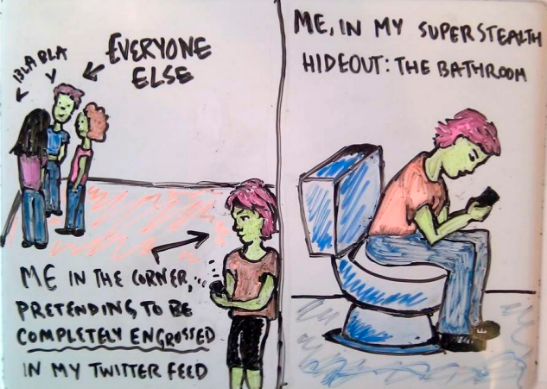
And yet, despite my many hours of practice surrounding myself with seas of strangers, I've often found myself hiding during the “social” times of many of those conferences. I hide in the bathroom during the networking hour, I hide in the bushes to eat my lunch, I hide in the hotel to avoid the after-parties. I even illustrated that in my "No, Really, I'm Shy" Ignite talk:

I love speaking to crowds, but as soon as I find myself actually in the crowd, faced with the threat of casual conversation, I get nervous. I worry about who to approach, what to say to them, and how to stop talking to them eventually.

I think its due to my social anxiety that I put extra effort into the social aspects of the events that I organize--because I don’t want to put others in the same situations that I dread. I am now actively working to be less socially anxious, but in the meantime, I want socializing to be easier for everyone.

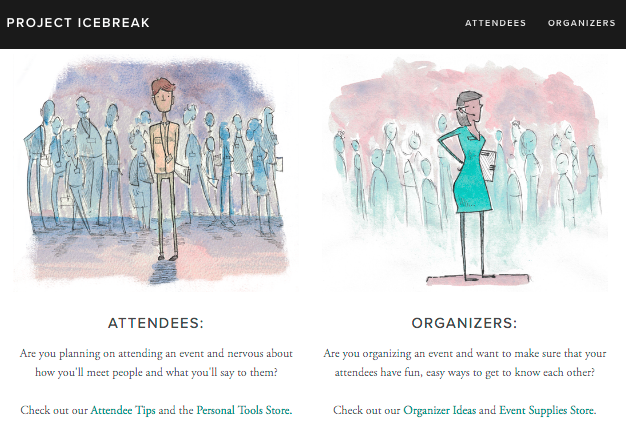
That’s why I’ve put together a website called Project IceBreak. It’s a collection of tips for attendees and ideas for organizers that I’ve been blogging over the years, plus an Etsy store with a few supplies.

The website has sections both for attendees and organizers, but the meat of it is about what you can do as an organizing- because there are a lot of ways you can give your attendees more ways to connect. That might sound intimidating, but here’s the thing: sometimes it takes just one tweak to an event to make it easier to meet people. For example, every speaker can start off their talk with “Now introduce yourself to the person next to you and tell them one thing you learned today.” That’s already one new guaranteed connection per talk for all your attendees!

So please, share this site with any event organizers that you know. Networking can — and should — be easier. Thank you!

Wednesday, August 17, 2016

Learning new skills in SF


I had lunch with an old colleague the other day. She was excited to tell me that she’d been inspired by my extracurriculars — the classes I was taking outside of work — and finally started learning singing. She had never thought of learning new skills as an adult before.

I’m here to tell you that, yes, you can learn new things as an adult, and yes, it’s awesome. Sometimes it’s a welcome break from your day job, sometimes it relates in unexpected ways to it, and sometimes it becomes your next job! Here’s a roundup of the new skills I’ve learned in SF:


There’s so much more you can learn in SF, of course — this is just to get you thinking about what you might learn and where. To find a class for whatever you’re interested in, I suggest starting with SF Rec (they’re subsidized, so they’re cheapest), then search Yelp and Google. You can also look at the online catalogs for local community colleges, usually quite affordable.

You can then try to find a friend interested in taking the class with you. Email any that are top of mind, or broadcast your intent on FB. Taking a class with someone is a great opportunity to bond — you’ll both get to fail in front of each other, get those vulnerable juices going! A caveat: if your friend isn’t a “Hell, yes!” about the class, don’t push them to register—in my experience, they’ll probably drop out, or you’ll spend the time worried about their enjoyment.

I’m actually posting this on the day that I start a 4 month Buddhism retreat at the Nyingma Institute. I took a 3 day workshop there a month ago and now I’ve decided to go deep. You never know where a class will take you! :)

Thursday, December 24, 2015

My "touchy-feely" takeaways

I recently took the weekend version of Stanford's "touchy feely class", COM 19. I had heard good/intriguing things about it from my colleagues, and in the spirit of trying anything communication-related once, my partner and I signed up.

The class revolves around this thing called a "T group", which is a group of 12 strangers sitting in a circle for hours, staring at each other, and talking only about things actually happening there and then. What do strangers have to talk about? A lot, as it turns out. We all feel and think things when we're in new situations, and we tried to express those honest feelings while in the circle (thanks to the help of a feelings vocab sheet in our laps).

Before and during the process, we come up with our personal learning goals, and we discuss those with our coaching group. These were mine:

  • I often resort to humor in tense situations. I wanted to be able to recognize the emotions behind that humor and express those instead.
  • I tend to avoid conflict, and if there is conflict, my instinct is to run and hide. My goal was to not run into the bathroom, metaphorical or actual.
  • I rush to judgment of others and am quick to point out the ways they're violating the rules. That's been a goal for me generally in life this year, so I made it a goal for T group.
  • I realized during the class that I didn't handle it well when another person expressed appreciation for me (I deflected or tried to hide), so I made a goal of learning to receive appreciation.
  • Similarly, I realized I wasn't giving as much appreciation as others, so I made it a goal to practice giving appreciation.

I definitely felt like I progressed in my goals, some more than others. I did find myself getting into "teacher mode" a lot, which often happens in classroom-like situations, and I wasn't as emotionally engaged in that teacher mode. I did take an awful lot of notes about the ways that facilitators worded things, though. Here are a few of my favorite phrasings:

Describing our feelings/needs:
  • “I noticed… I feel… Pause.”
  • “The story that I tell myself is…”
  • “My experience of you…”
  • “My wish for you….”
Discovering how others feel:
  • “I’m sensing that you… Is that right?”
  • “I’m hearing that you…”
  • “How did my feedback land with you?”
  • “How do you feel right now?”
  • “How did it feel when I said that?”
  • “Can I check in with you to see how you’re feeling?”
  • “Do you feel complete with our conversation?”
Responding to conflicts:
  • “It’s not about the mess, it’s about cleaning it up. Let’s celebrate it!”
  • “I see that she is trying to make a repair, and I want to recognize that.”
  • “I see that you’re going into a shamehole, and my wish for you is to not go there.”

I found it particularly helpful that my partner and I both signed up. They put partners in separate groups, so that we can get touchy-feely without the baggage of a relationship. However, we met up during meals, exchanged notes, and often challenged each other to go further in our learning goals. After the workshop, we were able to communicate better because we were both so used to expressing feelings, and we expected that of each other.

I recommend checking out the class if you're interested in communication and honest expression. It will likely be a very different experience for you than for me, but it will certainly be an experience either way!

Wednesday, December 23, 2015

Combining coding and teaching into a career

 I had a chat yesterday with a college junior who’s facing a conundrum: she realizes she loves computer science and teaching, and she’s not sure how she should combine those into a career. I both hope and think that there are many others thinking about that, so I thought I’d share my thoughts here.

First, let me go into the ways that I’ve personally managed to combine coding and teaching in my decade-long career.

Combo #1: Developer relations

Don’t know what that is? Most people don’t, and I definitely didn’t know what it was in college.  It’s a job where you spend your time helping third party developers understand how to use your company’s API - like by writing documentation, making demos, giving talks, and answering forum questions.

I struggled in my senior year of college with trying to find a job that appealed to my mix of interests, but when I happened upon a description of that role, it sounded like a perfect fit. And it was pretty damn cool. I spent nearly half a decade at Google, helping developers with the Google Maps API, Google Wave API, and other fun APIs like spreadsheets, gadgets, and even a 3d chat client.

Photo of Pamela speaking about Google Maps API
Giving a talk on sweet ways to visualize data with the Google Maps API

In what ways wasn’t the role perfect for me? Well, I didn’t love that I was spending my time promoting proprietary technologies. I wanted to give talks about open-source technologies and not feel limited to just Google’s. I also missed having in-the-flesh students, like I’d had as a TA in college. That was when I started a GirlDevelopIt chapter, which helped me with that need. (Tip: a job doesn’t always have to fill all your needs).

Combo #2: Engineering in EdTech

After Google, my next job was as one of the first frontend engineers at Coursera, a MOOC company. I treated it very much as an experiment, because I didn’t know if I’d enjoy a job were coding was my role 24/7 (or 30/7, since it was a startup).

As it turns out, it was a lot of fun. I really loved working on features to improve the learning experience for students, like better forums and clearer grading policies. I also loved working with professors and hearing their ideas for more engaging courses.

Screenshot of Coursera.org pages
Some of the student-facing features I coded in my year at Coursera

I was definitely missing teaching though. I got a bit of my urges out in a few ways: by giving talks about the technologies I used at Coursera (like Backbone, a hot topic then), by writing blog posts and documentation, by delivering internal trainings, and by continuing to teach GirlDevelopIt workshops.

I eventually got too jealous of the professors that I was working with: I didn’t want to just help them get their courses online, I wanted to try putting courses online myself. It just seemed so damn fun!

Combo #3: Teaching Online

That’s when I started eyeing Khan Academy. They didn’t actually have a job listed on the careers site for teaching coding, but that didn’t stop me (and shouldn’t stop you, either). I emailed them with a proposal of what my job role would be, went through a custom interview process that was 50% coding and 50% content creation, and began my job a few weeks after.

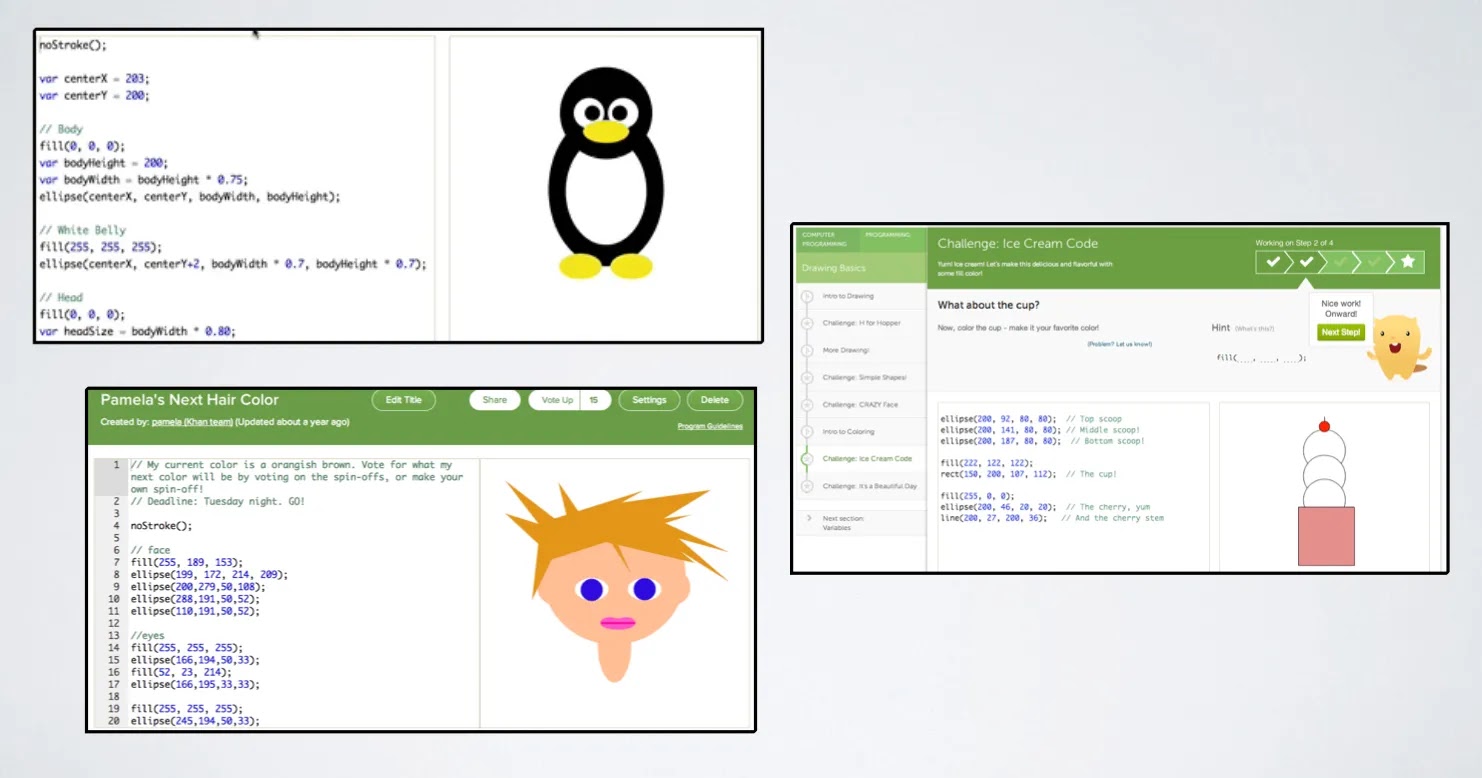
For the past few years, I’ve spent my time at KA creating courses and coding the platform that delivers those courses. Oh, plus my favorite part: interacting online with our community of creative coders, ages 7–70.

Screenshot of Khan Academy coding course webpages
The talk-throughs, challenges, and random programs that I make while teaching for Khan Academy

I still give workshops on the side, for GirlDevelopIt, CoderDojo, and GirlsWhoCode, but now I get to use my KA curriculum to power those workshops — so my full-time job and my on-the-side teaching gigs are very well aligned. I learn a lot from using my online content in physical settings, so I even consider those workshops to be a part of my job.

So, is there anything missing? As it turns out, yes. I still miss being inside a classroom with students that I see every day over a long period of time. I got close to that when I taught for GirlsWhoCode, but a 60 minute weekly club isn’t enough time to really get to know the students.

I’m going to look into opportunities for a more classroom-like teaching experience in 2016 - perhaps camps that are many weeks long and all day, or a class that’s several days a week with dedicated students.

What did I learn?

Okay, so I’m not there yet — I haven’t figured out exactly the combination of coding and teaching that I like. And in fact, I haven’t even talked about my attempts to integrate other hobbies - like art, writing, and myriad forms of creativity. But I’m getting closer. Here are a few tips to help you get closer:

  • Reflect on what you like and don’t like. Whenever you try on a new role or hobby, observe what makes you happiest about it, and what makes you saddest, and why. Build up a list so you can remember it for future decision.
  • Don’t feel tied down to a decision. It’s okay to take a wrong turn, like picking a job that you end up not liking as much. If you have a CS background and a good portfolio of your skills, you should probably be able to change jobs more easily than most. In this industry, it’s normal for folks to change jobs every few years, so future employers likely won’t look down on you for that. And you don’t need to regret the job - you can just think “well, the point of that job was to help me see what I don’t like” and thank the job for serving that purpose.
  • Don’t feel limited by the jobs that are listed. You can make up your own! My colleague calls this “job crafting.” Companies are good at listing the standard jobs that similar companies have, but there might be a job role they don’t have listed that they’d actually benefit hugely from. Write up a proposal of what that job role would entail and why you’d fit it well, and send it over to them. They might decline, but they might also say yes. Either way, you will have a better understanding of what you’re looking for in a job role.
  • Negotiate for your needs, whatever they are. A lot of times, when people talk about negotiating, they talk about negotiating salary and benefits. However, you can also negotiate for other needs that are important to you. For example, maybe it’s important that you’re able to spend one month every summer at a camp, or one day a week teaching. Tell your potential employer that, and see if you can put that in your employment agreement. It might mean less pay, but maybe that’s okay with you. Or maybe the employer will be willing to consider it a valiant work of charity. You won’t know until you ask.

What are all the options for combining coding and teaching?

I’ve only been out in the job market for 10 years, so I have not done an exhaustive search of all the many possible ways to combine coding and teaching. To recap, here’s what I tried:

  • Developer relations. There an increasing number of API companies out there looking for people to help them teach their APIs. See the APIStrat proceedings or browse ProgrammableWeb for ideas. Also check out my Developer Support Handbook for a better understanding of the role.
  • Engineering in EdTech: If you like teaching, you’ll likely enjoy thinking about creating online educational experiences. Check out EdSurge jobs board to see which EdTech companies are looking.
  • Teaching online: Anyone can create content on sites like Youtube, Udemy, or Lynda. You can also apply to be a creator at companies like TreeHouseCodeSchool, and Codecademy.

Here are other ways you might try:

  • Starting a CS education company. Jeremy Keeshin loved TAing at Stanford CS classes, so he co-founded CodeHS. Now he gets to spend some time touring classrooms to have them try out CodeHS while spending the rest running and coding CodeHS.
  • Doing CS education research. Colleen Lewis and Shuchi Grover are two women doing that today. You can get a much longer list by checking the proceedings of conferences like SIGCSE and ISTE. Some researchers teach themselves, like Colleen, others may just do a lot of observation.
  • Teaching at bootcamps. My friend Liz teaches at Galvanize, where she also gets to spend some time on content creation. My other friend Bianca started Telegraph Academy, a bootcamp for minority students. They don’t get to spend a ton of time on coding their own things, but they spend a lot of time helping students with projects.
  • Teaching in traditional schools. An increasing number of K-12 schools are looking to integrate CS into their curriculum, so I expect to see a spike in CS teacher job listings in the coming years. CS is also a popular major at many colleges. Teaching jobs likely won’t pay as much as other jobs, due to the sad state of teaching budgets, but they might be the most satisfying, depending what you’re looking for. (Update: I tried this myself, years after writing this post, and ended up leaving largely for salary reasons. Read my post for more details.)
  • Running internal training classes. Big companies have so many engineers that they often have their own internal trainers to help get those engineers up to speed with the technology they use. You might enjoy that if you like teaching professional topics to adult audiences.
  • Teaching on the side. There are a ton of clubs and organizations dedicated to teaching coding — global ones like GirlDevelopItCoderDojo, and GirlsWhoCode — and there are probably local groups near you like MissionBit in SF and ScriptEd in NY. There’s also the TEALS program, where software engineers can teach an AP CS class in an actual classroom for a semester. You might also enjoy tutoring a local student or wannabe-programmer.

I hope that helps y’all in your search for the role that will fit your needs and desires best. If a job is the best fit for you, it’s probably the best thing for the world for you to have that job, too. Good luck!

Wednesday, October 7, 2015

Voice coaching: What I learned

I use my voice a lot. I give talks at conferences, I teach workshops for GDI, and I record videos for Khan Academy.

But I’ve never loved my voice. I grew up with British parents, so I spent my life wishing I had an accent that sounded as smart as theirs. And now that there are videos of my voice on the internet and comments underneath those videos, I know that there are a few aspects of my voice that don’t always work so well, like the clarity of my pronunciation, upspeak tendency, and verbal tics.

I thought I’d go the DIY route first, by watching Youtube videos on how to have a British accent, figuring that’d solve all my problems. Unfortunately, that backfired - I attempted a more British pronunciation in my next video, and succeeded in sounding like I was speaking through marbles in my mouth.

So I decided to enlist the help of a professional: a voice coach. It took a bit of wading through singing voice coaches to find a coach that focuses on speaking for every-day life and presenting: Alicia Bales.

We started off with a consultation, where I described in my own voice what I wanted out of my own voice, and then she recorded my voice going through various exercises, like counting as high as I can in as high of a voice as possible. She wrote up a multi-page analysis of my voice with recommendations for key areas of improvement, and came up with a 12-week syllabus for how we’d get there. The full 12 weeks is a bit pricey, but thankfully, my employer Khan Academy agreed to count it as a professional development opportunity.

Over the next 12 weeks, we went through a wide range of exercises, in diaphragmatic breathing, tonal sounds, pronunciation, articulation, word emphasis, and more. I started noticing an improvement in my voice recordings after just the first few sessions, and a definite improvement after we were all done.

Here are some of my big takeaways from the experience:

  • I don’t need a British accent to sound “smart.” That’s what I told her the first day, and we proceeded to have interesting discussions about why I thought that, and what are the actual aspects of a voice that sound “smart.” Now, I’m happy with my accent, and I focus on having a clear voice and articulation.
  • I’m much more aware of my voice, and the states it falls into. I can tell when it’s low energy (when it “fries” - which isn’t as clear) and I have strategies to bring energy and clarity back into my voice.
  • I can see the correlation between my voice and my confidence. I go into a low energy voice when I’m in a situation where I’m intimidated or don’t want to be intimidated. Now that I can see that correlation, I can actively decide if I want to stay with that voice (like if it increases intimacy) or if I want to switch into a clearer higher energy voice.
  • I always knew that I “mispronounce" a few words due to the influence of British parents, like “idea” (idear!). Now that I’ve gone through entire vowel/consonant pronunciation worksheets, I have a full list of all the words/sounds that I pronounce in the more British way. I can actively decide whether to stick with that pronunciation or gradually move over to an American pronunciation (like “dodder” vs “dotter” for “daughter”). My voice coach was careful not to prescribe that I had to always use American pronunciation - she just wanted to make sure I was aware of it.
  • Diagram of breathingI have a better understanding of how breathing works, thanks to the diaphragmatic breathing exercises and binge-watching 3d simulations of breathing on Youtube. I was confused before by “breathing in” (which actually pushes the stomach out) and “breathing out” (which brings the stomach in), and always felt not quite right during meditation and yoga breathing. Now, breathing is coming more naturally.
  • I was always uncomfortable with therapists/therapy. After going through the experience of the 1-on-1 sessions with the voice coach, I became much more comfortable with the idea of a therapist (an emotion coach!), and I signed up for therapy soon after. The voice coaching was my gateway drug to more personal growth experiences. :)

I learned much more than that, of course, and I’m still working on applying what I’ve learned. One day, when I have time, I would love to have a voice study group to give me an excuse to be more regular about practicing.

I highly recommend voice coaching for those of you who feel a need. I loved getting to know my voice so much better and learning ways I could make it more of a powerful tool in my life.

Wednesday, September 9, 2015

What I learned from Burning Man


Burning Man is often described as a giant party in the desert. But I’ve also seen it described as “part entertainment, part therapy” and I think that description is much more accurate, at least for my own experience. Burning Man was a week of ups and downs, where I learnt about new ways of being, new ways of interacting, and new ways of thinking:

  • I learned that I still have a lot of social anxiety in new situations. I spent the first 2 days in an anti-social funk. I felt like I didn’t belong, like I wasn’t cool enough, like I didn’t know what to say or how to act around everyone. I eventually got out of the funk, thanks to a few nights of sleep and the emotional resets of the mornings, plus a reminder from my partner that other people felt that way too. I’m glad I got out of the funk, but I hope I can learn from the experience how to get out of funks faster - or how to avoid getting into them to begin with. I’ve seen how important my first interactions and thought processes are in new social situations, so I need to really prepare for those, so that I can start off on a good social foot.
  • I learned how to let go of accomplish-all-the-things mentality. Burning Man is chock full of workshops, and I love workshops. I was hoping to fill my day with workshops from 9 to 5 to make sure I got to experience as much as possible. But I soon realized that it just wasn’t possible/desirable to fill my schedule to the brim and experience the rest of Burning Man culture. I wanted to get to know my campmates, so I chose to have long breakfasts in the morning, meaning I missed all the morning workshops. I wanted to experience the offerings of random camps, meaning I sometimes missed afternoon workshops too. At first, I wasn’t happy about all of that workshop missing, as I was thinking to myself how much I was missing, but then I’d remind myself that if I’d never know about a particular workshop to begin with, then I wouldn’t be stressed about missing it— so why should I stress now that I knew it existed? There are lots of things that we all miss ever day that we don’t know about, and our lives go on.
  • I learned new forms of group play. There was an entire camp devoted to different forms of contact between people, and I got to experience a few of them:
    • Contact improv: It’s hard to explain what this is, at least in writing. It’s connecting physically to another person, like with your hand or arm, and moving with each other. It’s like a conversation between two bodies, and it can be both intense and fun, especially when you start lifting each other. It was also a good experience for my partner and I to do together, as it meant watching each other get quite physically close to people besides each other, and being okay with that. Mostly okay. :)
    • Ecstatic voices: We spent the first half of this workshop making sounds. Then we sat around in a “sound circle”, spending 30 minutes listening to ourselves, listening to each other, and making sounds inspired by our own inner voices and the external voices around us. At times, there would be harmonies and crescendos, and at other times, it would be a complete cacophony. It was fantastic to release all that sound energy in the group circle.
    • Acroyoga: One of my campmates is a yoga instructor, and offered to teach Acroyoga one day. I was the only one that took her up on the offer, so I got a private lesson. I first experienced the “lunar” side of Acroyoga - the more therapeutic side where the base stretches the flyers in ways that feel so good. Then we played with the “solar” side - the more acrobatic side where the base gets the flyer into positions that look impressive and that really feel like flying. My campmate told me that she originally got into Acroyoga when she was single and lonely, and she found that the physical interaction of Acroyoga was enough to lift her out of a loneliness funk. After my own session of Acroyoga with her, I could definitely see that benefit.
  • I learned new forms of meditation: I typically think of meditation as sitting in one spot, listening to a voice tell me what to do and how to breathe. I discovered many other flavors of meditation in the Burning Man schedule and tried out a few:
    • Singing bowls: This was the closest to what I think of as meditation. We sat around a man who alternated between singing and making sounds by tracing his fingers around bowls. It was beautiful, and an opportunity for me to see if I could declutter my mind without a narrator. (Not that well, yet!)
    • Laughter meditation: I walked into a room full of people walking around and laughing, and assuming that I missed the instructions, I joined them, alternating between forced laughing. and spontaneous laughing at the ridiculousness of it all. We then laid on the floor in what I know as the “Ha ha game”, where each person lays their head on the next person’s belly, and you attempt to make each other laugh by laughing yourself. We laid there for the rest of the time, emitting all sorts of human and animal laughter sounds, and I loved it. 
    • Deep listening: This was halfway between meditation and voice coaching. As a group, we both made and imagined sounds - like my favorite, the sound of a nearby waterfall, growing louder as we got close and stepped under, then growing softer as we walked away. We also listened to the sounds around us and tried both “inclusive listening” (focusing on a single sound) and “exclusive listening” (taking in all the sounds at once).
    • Chanting: My partner and I walked into our camp’s dome one day to find a circle of campmates chanting. We joined them, and proceeded to chant the same two “sentences” over and over. It was beautiful, and put me into a very relaxed and open state. 
  • I learned to be more comfortable with affection. Burning Man culture is huge on hugs. New strangers hug each other when they meet each other, and I was very adverse to that at first. I thought to myself, “No! You have to earn a hug first! You can’t hug strangers!”—but I eventually came around to appreciate the awesomeness of that much affection and warmth. I even had a few very-long hugs with friends, managing to stay in them without making awkward comments the whole time.
  • I learned how to be more comfortable in my body. No, that doesn’t mean that I spent the week naked. But many folks did spend it naked, or near-naked - and seeing their comfort with their bodies helped me have more comfort with my own. If all of them were okay enough with their bodies to walk around with them on full display, then why shouldn’t I be okay with mine? Maybe next year, I’ll show my belly to the world. Get ready! :)

Besides learning a lot, I was also very inspired by the creative and participatory nature of everything. I hope to find ways to bring more of that back into the "default world."