Friday, February 9, 2018

Dear Universe: A Mealtime Blessing

(This is cross-posted from Medium, where it's better formatted)
For most of my life, I was wary of religious rituals. I was never able to summon up belief in a deity or deities, and I assumed that if deities weren’t real (at least in my mind), then rituals must be false as well.
I’ve grown up a bit and come to realize that religious rituals are often about more than just professing belief in a particular deity. Many of them also help us humans foster feelings of positivity and community, plus provide avenues for introspection.
I’m now comfortable bringing rituals back into my life, and figuring out how to adapt rituals to my particular beliefs and values.
My favorite daily ritual is the mealtime blessing. I start each blessing with “Dear Universe…” and then continue on to give thanks and recognize the interdependence in our lives.
For example:
“Dear Universe: Thank you for these yummy looking veggies that will give us energy today. Thank you to the farmers who grew and picked them. May all the beings today find the energy to go about their day in the world. Amen.”
Or, on a weekend:
“Dear Universe: Thank you for this bright and sunny day. We’re grateful that we have the time to walk outside and enjoy it. May all the people and cats and other beings enjoy a bit of rest on this Sunday. Amen.”
It’s nice to start off each meal with a gratitude practice, to skew our minds towards the positive as we go into eating and conversing.
I’ll admit, I was pretty self-conscious about saying mealtime blessings at first — and I’m still nervous saying them in front of friends that are new to the tradition. But it gets easier over time, and it’s worth the cheek-blushing. 😊
Here’s a little bonus variation for the improv’ers out there: now that its a regular habit with my partner, we sometimes come up with the blessing together — either by alternating lines or even by attempting to say the same words together.
The mealtime blessing is a simple ritual, but so very helpful. Try it out for yourself and see how it feels for you.
I wish you all well in the quest to cultivate a life of positivity and meaning.
Thank you to Jacob Lyles for starting the mealtime blessing tradition, and to BeAndBeWell for inspiring it.

Saturday, February 3, 2018

Sleep strategies for a racing mind

(This is cross-posted from Medium, where it's formatted better)

My mind doesn’t stop thinking.
Or at least, it really doesn’t like to stop thinking, so it’s always very reluctant when my body says “hey mind, guess what?? it’s sleepy time!”

At that point, my mind needs to slow down enough for my body to be able to accomplish its goal of resting. I’ve been trying different strategies to slow my mind down since I was a kid, and I finally found a few that worked.
I know there are 5 billion posts of ways to fall asleep, because I personally have read 1 billion of them, and well, here’s one more! Bonus points if you’re reading this while trying to sleep.

Pre-req: No phones in the bedroom

I have proven to myself time and time again that I absolutely cannot have a phone within easy distance of my bed. Why? Well, when I can’t sleep, my mind says “Oooo, let’s just figure out how to do thing X or solve problem Y, a few Google searches won’t hurt!” 2 hours later, 20 browser tabs, and 2 Pinterest boards later, I’m even farther away from being able to sleep, as I’ve gotten my mind all excited about something.
Now, each night, I plug my phone into the only charger in my house, conveniently located not in my bedroom.
What about the bedroom-y features of a phone, like an alarm clock or soothing sleep-inducing sounds? I’ve replaced those with Amazon Echo Dot, which provides all those features yet does not make it easy to browse the internet for hours. Phew!

Pre-req: No chocolate after 5pm

The only form of caffeine that goes into my body these days is chocolate, which means my caffeine tolerance is super low. If I eat any after 5pm, the caffeine will still be in my system when I’m trying to sleep, since caffeine has a half-life of 5 hours. Even a hot cocoa at 8pm can keep me up until 2am.

Pre-req: Bedtime Supplements

I was resistant to trying supplements for a long time, as I wanted to try to accomplish my mind-calming without any external dependencies, but then I realized getting a good night’s sleep is so beneficial that it’s worth it to try anything.
My current favorite supplements are NightRest and Magnesium. I’ve also used Melatonin, a fairly popular supplement for sleep, but it’s a little too powerful and changes my wake-up state significantly.

Bed Setup: Heavy blanket and furry sheepdogs

I do not believe I have autism, but I keep discovering that I benefit from products originally designed for those on the autism spectrum. My sensory system seems to work similarly, methinks.
One of those awesome products is heavy blankets. They’re blankets that are weighted down with pellets equal to ~10% of your body weight, and are often made with fantastically fuzzy material. A sensory delight! Researchclaims that they calm the body down via “Deep Pressure Touch” which releases serotonin. Personally, I find that they help me get to sleep, and if I’m bawling, I’ll stop crying as soon as I lay underneath my cozy heavy blanket.
Another sensory delight in my bed is my “sheepdog”: a stuffed elephant with an IKEA sheepskin lovingly hand-sewn on top. I rub my face on the fur for 10 seconds and get so overwhelmed by happy tingly sensations that I forget everything I’d been thinking about it before. Furry calmy time!
I must confess: I no longer have either the blanket or the sheepdog in my bed, as I sleep with my partner now and find that his presence has a similarly calming effect on my system. His hair also has the same texture as the sheepdog. 😁 My brother is happily using the heavy blanket now!

Sleep-inducing Strategy #1: Counting Breaths

As a kid, I was always told to count sheep to get to bed. Every time I tried it, my mind would get itself into a tizzy instead. While counting, my mind was desperately trying to decide what color each sheep was, what the fence looked like, how gracefully they jumped, every last detail of the scene!Generally, my mind overanalyzes whenever it attempts visualizations, so I very rarely find visualizations helpful for calming it down.
However: counting breaths is totally doable, because my breaths actually exist (no offense, sheepies). Just as I do in meditation, I go for deep belly breaths and I count on the exhale. My mind still totally has thoughts, but its less likely to get stuck in thought loops.

Sleep-inducing Strategy #2: Progressive Relaxation

Progressive Relaxation is a super useful technique that you can use for releasing tension at any point during your day and to give your mind a break from thoughts for a hot second.
The basic idea is that you tense parts of your body for 8 seconds, then release that part, and you keep tensing and releasing different parts of your body. You can start at the bottom with your toesies and work your way up, or vice versa. For a quickie, you can tense every muscle at once, and then release it all.
I often find I don’t have the willpower to guide myself through a progressive relaxation, because my mind really-really-really wants to think about something else. In that case, I listen to a recording that will guide me through. There are hundreds of recordings on Youtube that you can sample, including my very own version here.
Still feeling tense? Do it again! In the right situations, it can work wonders.

Sleep-inducing Strategy #3: Bedtime Stories

Little kids know where it’s at. If I get told a bedtime story that actually interests me, I’ll happily nod off to sleep, often mid-story. A former partner of mine is a brilliant improvisational story-teller, and I was always happy when I managed to convince him to make up a story for me. He wasn’t always happy when I’d fall asleep before the end of the story, so we started recording them for posterity. We even turned one of them into a real(-ish) children’s book.
I’ve tried finding engaging bedtime stories on Youtube, but most of them are too targeted at children. If only Pixar made bedtime stories, aye?
Relatedly: I sometimes read short stories before bedtime, like from Asimov, Bradbury, or Dahl. That doesn’t work quite as well, as they often engage my mind a bit too much. They do at least distract my mind from trying to solve problems in my life, which is what tends to keep it up the most.

Sleep-inducing Strategy #3: Sleep Talkdowns

In a sleep talkdown, a nice stranger from the internet talks to you and tries to talk you down into sleep. They may guide you through deep breathing and progressive relaxation, they may remind you that everything is okay, and they often fill in the blanks with whooshing ocean sounds. There are thousands of them on the internet, so you can try a different one each night and see which works for you. This is my favorite sleep talkdown. It’s 30 minutes long, which isn’t always long enough to talk me down, so I will happily play it twice.

That’s All, Folks

These days, I get to sleep within 20 minutes of tucking in, thanks to these variety of strategies. That’s really short for me, so I’m a happy camper now.
If you’re reading, I hope you find a new strategy here that works for you. Feel free to respond with your own experience and suggestions.
And with that, I’m off to sleep. 😴

Monday, January 22, 2018

Beware the Near Enemies (In Life & Tech)

I’ve been in the tech industry since I was just a wee lass.

Last year, I took a break from tech, and decided I wanted to understand the inner circuity of my mind.

I eventually found myself on a 4 month Buddhist retreat, where I had ample time to study my mind and the Buddhist philosophy of mind. I learnt some ways of thinking that I find useful now that I’m back in the tech industry, and here I want to introduce one of the most powerful concepts: “near enemies”.

First, some background. Disclosure: I am just a Student Buddhist, so please feel free to research further everything I discuss here.

Buddhism has a set of virtues called The Four Immeasurables. When a Buddhist takes the Bodhisattva vow, they dedicate their entire life to cultivating those virtues. Here’s a summary of them:

  • Loving-kindness: wishing well towards all beings.
  • Compassion: recognizing the suffering of others and wishing for them to be free of suffering.
  • Empathetic Joy: rejoicing in the joy of others, even if it is not your own.
  • Equanimity: even-mindedness and serenity, treating everyone impartially.

Buddhists and lay people alike can cultivate these virtues by special meditations and daily-life practices. Stanford actually offers an entire course for compassion, Compassion Cultivation Training, a secular version of the Buddhist techniques. (I’m now taking that class for the second time!)

They all sound really lovely, right?

So here’s the thing: whenever you train in these virtues, you are also taught about the “far enemies” and “near enemies” of each one. The far enemies are fairly straightforward: ill will is a far enemy of loving-kindness, cruelty is a far enemy of compassion, jealousy is a far enemy of empathetic joy, and paranoia is a far enemy of equanimity.

But the near enemies are things that look so close to what you’re trying to cultivate, but are actually fundamentally different in a dangerous way.

For example: the near enemy of loving-kindness is conditional love — selfish, sentimental attachment — when you wish well for others only when they make you happy. It’s like when you say “I love ice cream.” You are not wishing well for the ice cream, you are wishing for the ice cream to bring your mouth pleasure. Ever used “I love” that way with humans? I have!

So when you learn the Four Immeasurables, its crucial that you also learn the near enemies, because it is so incredibly easy for us to confuse the near enemy for the real thing. Those near enemies feel similar emotionally and rationally, but yet, they’re not the real virtue at all.

Here’s a diagram of the Immeasurables and their enemies. If you research them, you may find slightly different enemies from various translations and teachings. Its interesting to find those and consider them as well.

On a personal level, I’ve found it incredibly helpful to remember the near enemies. For example, I’m always working on reducing my anxiety and being less emotionally reactive (being more equanimous, a word I can rarely pronounce). However, I’ll admit I often fall into the near enemy of disassociation and indifference. Thankfully, since I am aware of that near enemy, I can realize when that’s happening and apply the antidotes.

Awareness is always the first step.

Near Enemies in Tech

Okay, so how does this relate to the tech industry?

We’re a very data-driven industry lately. We have to be, because when we’re making products that operate at a global scale, we need a way of zooming out on our thousands or millions of users, and understand how they’re using our products.

So we end up picking metrics: the numbers that we want to put in our graphs, the numbers that we want to go up-up-up, the numbers that we base our idea of success on.

Many of us work for companies that measure user “engagement”, the number of times users engage with our product each week. We think of that as a good measure because we think, well, we are making a useful product, so the more users use it, the better it is for them!

But more often that not, that user engagement number isn’t actually telling us how much usefulness a product is adding to users’ lives — that number is a near enemy, a number that looks deceptively close to our hopes and dreams, but could be closer to our fears.

I’ll give you a specific example from my career. At Khan Academy, I created the computer programming curriculum. I wanted to give students the joy of creativity from coding. Each week, I reported how many minutes students spent in the programming playground of our site. One week, it went way up! Amazing!

But, actually, that was the week that someone put a clone of Flappy Bird on Khan Academy, and students were just playing it nonstop. Oops, my metric was measuring addictiveness! Not what I wanted to achieve at all.

That was the point where I realized that I needed to get much more specific with what I was measuring, like recording how often they successfully fixed a bug in their code or how often they provided a helpful answer to another student’s coding question.

It’s a lot harder to measure what we’re really trying to achieve for our users, and that’s why we often settle on the easy numbers, the approximations.

As I saw for myself, we must be careful about blindly optimizing for simple engagement metrics. This table from TimeWellSpent.io shows how user happiness and regret correlated to time spent in an app:

Ideally, we could measure very specific metrics that truly capture usefulness. Or perhaps, when we come up with metrics, we can think very hard about what non-desirable outcomes they might accidentally measure (what ways that metric might mislead us), and then make sure we also measure those counter-metrics alongside them. Basically, each metric has near enemies, and those get recorded alongside it.

Andy Matsuchak gets into other great ideas around this in his post on Exalting Data, Missing Meaning.

There’s another place in tech where I find the concept of near enemies very relevant: company values. Each company comes up with a set of values, a bunch of feel-good words like Respect and Collaboration.

That’s great, but what do those values really mean?

What does it look like if you’ve achieved that value? And what is the near enemy of each value? What do you need to look out for, to make sure you’re not just achieving the superficial version of the value?

That seems like a fascinating discussion for a company to have, one that would yield real insight into each employee’s interpretation of the values.

Beware the Near Enemies

I imagine that many of you already had a concept like “near enemies” in your head. I love the Buddhist terminology so much that I want to put that phrasing in your head as well, because I think it captures so well how easily we can fall into the near enemies, plus how dangerous they can be.

May you be aware of the near enemies both in your personal growth and product development, and may that awareness guide you back onto a path towards your true goal. Thank you for reading!


Sunday, August 20, 2017

Oops, I forgot to have kids

(This is cross-posted from Medium, where it's formatted better)
When I was in middle school, I realized one day how old my parents were compared to other people’s parents, and I decided then that I would have kids before 25 — I would break the cycle! Lots of other kids grew up with alive grandparents, I wanted to give my future kids a shot at getting to have grandparents.
When I was getting near the end of college, I gave up on the goal of kids by 25, but I made a promise with my best friend that if we weren’t both married by 28, we’d move in and adopt a kid to raise together. A strange plan for 2 straight women, but we figured we’d never have to execute on it. She got married soon after, so the plan never came to fruition.
Now I’m 33, and I don’t have kids yet. There’s maybe a 20% chance that my current partner will be ready for it any day now, but the days keep passing and my ovaries keep getting more wrinkly.
So what happened? Why am I now facing the prospect of being an old parent (like my own parents) or never being a parent at all?
I always prioritized work over relationships. I remember a specific point where I could have chosen to take a worse job in order to be in the same city as my long-time partner, and thinking to myself, “no! work over boys!” I believe I learned that from my workaholic dad, and misunderstanding his grievances from having made work-related decisions to please my mum. I’m only now at the point where I would be willing to prioritize starting a family vs starting the perfect job, after seeing where my priorities have landed me.
I rarely saw babies. For most of my years in the tech industry, my colleagues were either young or they were men, so it was rare to encounter babies or pregnancy at work. I didn’t have any friends at that stage in life yet, and I also have little contact with relatives (as they’re all overseas), so I’ve never met a baby I was related to. Actually, my dad did have a second daughter with a new wife, who would have been in her baby years while I was in my late 20s, but I was busy working at Google and I did not meet her until she was the ripe old age of 9 years old. In the olden times, I imagine it would have been hard for a woman to go through as many years of their 20’s without seeing lots of babies — so it’s kind of fascinating how I managed to!
So I forgot about babies and didn’t realize the years were ticking by.Adults were always a foreign species to me, and it took me a long time to identify as one. I always thought there’d be a day that I’d wake up and think “Aha! I’m an adult now!” and that’d be the day that I’d start tackling all the adult goals. How can a kid have a kid, after all? But then I saw the baby announcement of one of my old high school friends— someone who I didn’t think was “adult” yet — and realized that I’d probably confused cause and effect. I started to realize that there wasn’t actually a “kid/adult” toggle in my brain, and that I was indeed at the age where humans make other humans.
Around the age of 30, things changed. I started dating someone who liked the idea of one day having kids, and brought it up early in the relationship. That got my brain ticking on it again. I also started being around a lot more kids, thanks to Khan Academy employees being very babyful and bringing their babies to company events. I also had a surgery that was potentially risky for my future fertility, and that really brought the point home that my fertility wasn’t forever.
But I didn’t feel emotionally prepared. The mums in my family have a history of becoming excessively anxious once kids are in the picture (and that is an understatement), and I didn’t want the same thing to happen to me. I never wanted to take the time to work on my mental health though, because work always seemed more fun/pressing. In the last few years, I’ve become more mentally stable/confident, thanks to finally investing the time in various forms of therapy and a 4-month long Buddhist retreat. Only now do I feel okay with the idea of bringing kids into the world, as I’m no longer worried that my mental health will deteriorate to the point of inflicting suffering on them. Or at least, I know a lot more about ways I can get help if that does happen.
These days, I’m ready and willing to have kids. Sure, it still seems like the scariest thing in the world to me (especially the labor part and the worry-about-kid-dying-forever part) but scary in a worth it kind of way.
But I don’t know if it will happen for me in time. It’s easy for me to accomplish goals that involve only me, but it takes 2 to tango for 20 years, and that’s a goal that I don’t particularly know how to achieve.
I write this because I wonder if others find themselves in the same place, and I worry about accidentally encouraging others along my exact path, especially given how often I speak to girls and women about coding. Ideally, I’d like to inspire females to try out coding for themselves, but not set themselves up for a life where they work at the expense of everything else. Given that I haven’t succeeded in that yet, I don’t think I’m a particularly useful role model.
But maybe there are ways that the tech industry itself can be more encouraging of reproduction:
  • More family-friendly work events. My early years in tech were peppered with alcohol-fueled bonding events, rightly devoid of babies. These days, tech isn’t as into alcohol as a bonding tool (for obvious reasons), so we’re seeing more daytime family-friendly events. Yay, reproduction reminders!
  • Family planning education for 20-somethings. I remember going through Sex Ed in high school, and they did a great job of scaring me away from having kids then (thanks to a graphic film called “The Miracle of Life”). But then, I never got another class later on to un-scare me from having kids. I’m not sure whether such a thing would be offered by work or by health care providers, but it’d have to be an obvious enough option that I’d attend it, even if I wasn’t actively thinking about it. It would be a class for all genders, of course.
  • More career options that aren’t in expensive cities. I hear that SF has a low birth rate, and that could be related to couples not wanting to start a family in a place where they can’t have a proper house or even live without roommates. It could also related to city-dwellers being more into nighttime events than daytime family-friendly events. Either way, it seems possible that if more people worked for tech and didn’t live in costly cities, they’d be more likely to start a family.
  • Corporate policies like maternity/paternity leave. These become helpful once you’ve actually remembered to have kids and are going forward with the decision, to make sure that work doesn’t become a reason not to have kids. I don’t know much about them since I haven’t made it this far.
Having said all that: a caveat. Not every woman wants to have kids. I don’t believe in any approaches that’d impose such a desire upon others, or that would shame people for either wanting or not wanting kids.
I’m just sad that I forgot.

Sunday, August 13, 2017

Coding: A Hobby for the Waste-Adverse

I love creating things and I’m a high energy individual. I can spend all day creating things, enjoying both the process and the output.
For most of my adult life, I’ve channeled my creative energy into coding. I studied Computer Science in college, and went on to jobs at Google, Coursera, and Khan Academy. Even in my year of “recovering from corporate life” between Google and Coursera, I spent my time coding web apps and browser extensions for fun and no-profit. ☺
This past year, I got back into other forms of creativity. I learned woodworking and laser cutting, making signs and jewelry out of wood. I worked on a Burning Man art project with a team, turning a giant gumball machine into an LED ring dispenser. I ran art events with my partner, showing other people the joy of painting for fun. I adore the sensory aspect of those forms of creativity —the smell of wood when I sand it, the gooeyness of paint — the feeling of using my body in the creative process.
This summer, I finally returned to coding as my full-time form of creativity. And actually, there’s a big part of me that breathes a sigh of relief: the part of me that doesn’t like to accumulate excess and create waste.
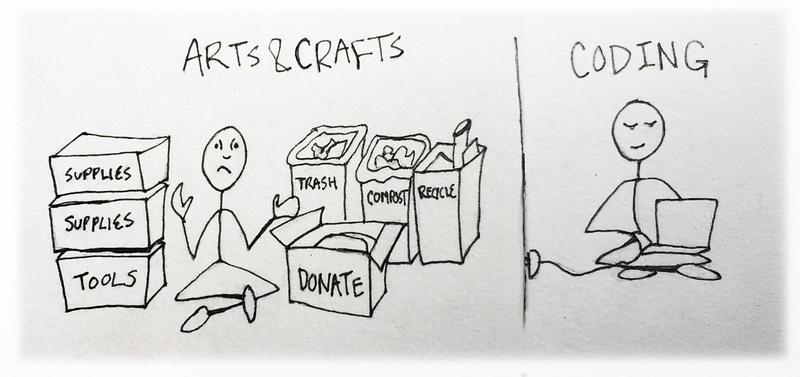
To create things that live outside the digital world, I need to acquire the supplies, shape them into the thing, and then discard or donate the unused part of the supplies. Sometimes, I can “reclaim” the supplies, like when I pick up driftwood on the beach, but then I still need to acquire the tools, like the woodburning iron, power drill, etc. I also need to find a place to store the newly created item or someone to give it away to. I sometimes sell things on Etsy, but then, I need to acquire the shipping supplies.
To create things that live in the digital world, I only need my laptop, electricity, and a bit of disk space. I can share things easily with others (without needing new disk space!), and if I’m done with them, I can delete things to reclaim that disk space. I can acquire “supplies” by a quick download, and easily delete supplies I no longer need.
Isn’t that great? It’s great! A way to use up my creative energy without excessive accumulation and waste! Phew!

This post is not a declaration that everybody should stop creating physical things, or even that I will stop creating physical things. This is also not a thorough analysis of the overall sustainability of a world of digital technology.
This post is simply an observation of a benefit of coding that I hadn’t truly appreciated before. Thank you, coding.☺

Sunday, May 7, 2017

My Morning Practice


(Spoiler alert: it’s not just meditation.)

Each morning, I sit in front of my altar and go through a sequence of practices, each of them important to helping my mind and body prepare for the day. I got into the habit of morning practice while on retreat at the Nyingma Institute for Tibetan Buddhism, and I’ve been doing my own morning practice in the four months since graduating. I’m able to keep up the practice only because I can so clearly see the difference on days that I don’t manage to do it.

I am sharing my morning practice because I want to encourage others to experiment with their own morning practice, to consider what practices can help you feel the most balanced and open as you enter the day.

The Setup: My Altar


I’m happy that I went through the effort to create an altar area in my bedroom, as the visual reminder helps me establish and continue my practice. My altar is filled with imagery that inspires me: a Buddha statue in the center of a sand-filled star, lit up by a glowing candle, surrounded by sea shells from local beaches. My altar also has photos and statues gifted from friends, and handmade engravings of the Buddhist compassion prayer.


If you have the time and space to create an altar, let it be one that inspires you — whether that’s shiny stones, spiritual figures, photos of friends, or doodads collected over your lifetime. That important part is that it gives you a sense of beauty and balance.

At the foot of my altar, I always have a meditation cushion, a blanket, a lighter, and a tissue box.

The Prerequisite: Waking Up Early


I find it far easier to do my morning practice in the early morning before my roommates have awakened. I tried many times to do it during the hustle-bustle of the morning rush, and I just can’t relax enough when I have the niggling worry that they might need me for something.
Setting my Intention

I start off with reciting my personal intention statement, three times. I recite the same intention each day, and it reminds me of what I strive for in my interactions with others:
“I intend to be warm, friendly, open and loving, while honoring my interests and respecting my boundaries.”

Sitting Meditation


I sit in the Tibetan style, my eyes partially open with a soft gaze towards my altar. I count my breath each time I exhale, counting 10 exhales before I start back at 1. For each cycle of 10 breaths, I shift my gaze to a different sea shell on my altar. On my 7th cycle, my gaze will rest on the center seashell with the candle light gleaming through it, and that is how I know I am done.

Often, the goal of meditation is to focus on a single object, just the breath or just a particular object. In my meditation, I focus on multiple objects at once, because it is the way that I can pay the most attention to what is happening in my mind without it wandering completely away. It works well for my purposes.


“Cleansing Breath”


This is a highly beneficial practice from Kum Nye Tibetan Yoga that helps me acknowledge my aversions, attractions, and ignorance.

With tissue in hand, I first think of something I’m averse to or afraid of (like an awkward conversation or a tricky task), place one finger on my right nostril, inhale, and then blow out through my left nostril. Then I do that for 2 more things I’m averse to, 3 times on the other nostril for things I’m desiring, and 3 times from both nostrils for things I’m uncertain about.


It may sound weird, but hey, this one weird trick — it works! When I fully acknowledge the things that are gripping me — whether it’s a grip of desire or disgust — I am less under their control. I can detach myself from them. When I acknowledge the things I’m unsure of, I find I don’t put so much energy into defending myself, both internally and to others. I can just say “Actually, I don’t know!” and be okay with it.

If you’re interested in practicing Cleansing Breath, I recommend reading the full description in Tarthang Thulku’s Kum Nye book. You could also try journaling the 9 attractions, aversions, and ignorances.


Neck Stretches


This is where my practice gets physical, and is inspired by both Kum Nye and Mask Theater class warm-up. I basically stretch my throat and neck in a mindful manner. In Kum Nye, it’s considered important in opening the channel from the head to the heart chakras. In Mask, it’s important to enable our characters to express themselves fully.

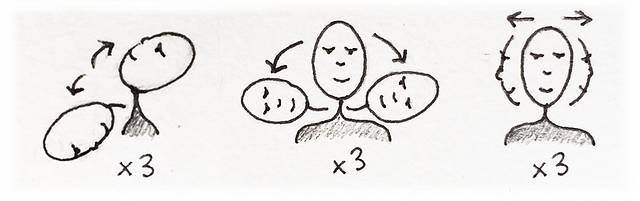
First I rotate the neck in 4 axis: top to bottom, left-ear-to-shoulder to right-ear-to-shoulder, and left to right. Each time I rotate, I notice a new thing that my eyes have rested on, to increase my mindfulness.


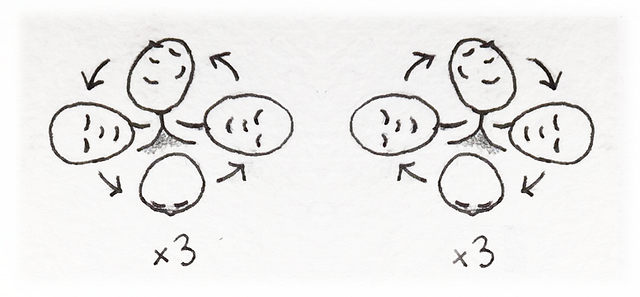
Then I do a slow neck roll, 3 times in one direction, then 3 times in the other direction. If any part feels particularly “juicy” or “crunchy”, I spend a little more time there. This is similar to the Kum Nye practice “Lightning thoughts”, where your neck roll is as slow as possible and you observe the thoughts popping up.


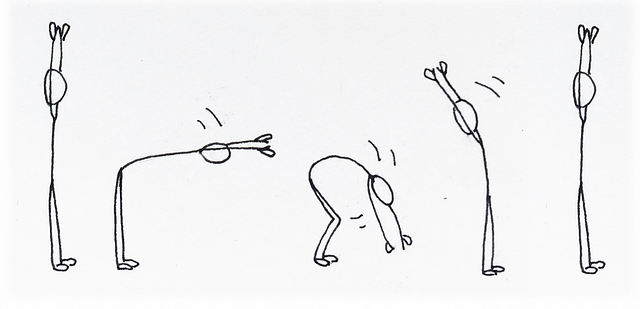
“Bending in the Four Directions”


Now I’m well prepared to get up on my feet and bend my entire body! This next practice is also from Kum Nye Tibetan Yoga and a great example of its power. When you do Kum Nye poses, you go through them very slowly and often hold them for many minutes. That way you can take the time to truly experience the sensations happening, and even try to develop a friendly relationship with sensations you may label as uncomfortable or painful. Kum Nye gives you the time to develop mindfulness around your bodily sensations, and can prepare you for more mindfulness in the “real world”.

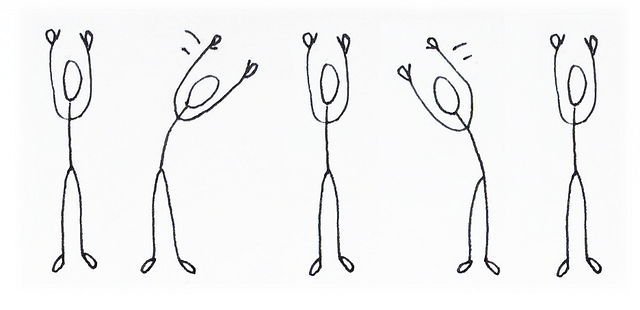
In this practice, I slowly raise my arms up to the ceiling and bend to the left. I count for 21 breaths, and return to the center.

Then I bend to the right for 21 breaths. If I feel myself getting distracted, I challenge myself to bend further. I return to the center and stretch upwards.


Now my favorite/most dreaded part. I bend forward from the waist until my arms are parallel with the floor. I reach my arms forward while jutting my hips back, and count for 21 breaths. The concentration needed to hold the pose is often strong enough to clear my mind of distraction.

From the bent forward position, I bend my knees and swing my arms up to center. I stretch backwards slightly, staring at the corner where the ceiling meets the wall, counting for 21 breaths.


I return my hands to center and slowly lower them, noticing the sensations going through my hands, arms, and body.


The Compassion Prayer


This prayer comes from the Four Immeasurables in Buddhism, and there are many variants of it. I recite this version three times:
May all beings be free from suffering
May all beings be free from fear and anger
May all beings find peace and joy
May all beings have a mind at ease


Closing Gesture


We always close sessions at the Nyingma Institute with either a closing gesture or closing chant, where we dedicate the merit of our practice to all the beings that may benefit from it. While I go through the gesture, I think of my roommates, colleagues, neighbors, locals, and then imagine extending it to everyone in the state, country, and world.

Thursday, April 20, 2017

What is the difference between ambition and discontent?


I am honestly trying to figure this out right now.

“Ambition” is defined as “desire and determination to achieve success.”.

“Discontent” is defined as “dissatisfaction with one’s circumstances”.

Is it possible for one to desire to achieve success, if they are not dissatisfied with their circumstances?

Or, to bring this out of abstract realm and put my skin in the game: is it possible for me to desire to achieve success, without a dissatisfaction with my circumstances?

It seems theoretically possible. I could think “Well, things are alright right now and I’ll be content if they stay this way, but it’d probably be better if I was able to improve this thing, so I’ll try that out.”

Sometimes I do have that mindset. But after I put thingX on my TODO list and the fantasy of finishing thingX taunts me, my mindset soon turns to “Gosh, I just won’t be satisfied until I improve this thing! And look at all these other people and things taking up my time, preventing me from getting thingX done! I really really want to get it done!”

My preference for achievement turns into a desire, and that desire turns into an obsession, and that obsession turns into anxiety.

Why does preference turn into desire? Why can’t I avoid discontenment?

Let’s take a tangent into etymology land, to see what it yields.

The word “content” comes from Latin contentus, meaning “contained, satisfied”, as in “their desires are bound by what he or she already has.” Thus, the state of discontent is when your desires reach outside what you already have. You must achieve that thing outside of you in order to become content again, and hope that you can keep that thing inside your bounds.

The word “ambition” comes from Latin ambitionem, meaning “a going around”, as in the act of going around to solicit votes — “a striving for favor, courting, flattery; a desire for honor, thirst for popularity”. Apparently in its early uses, ambition was always used pejoratively, and the positive sense is only from modern times.

I must say, that was a very interesting detour. So much is contained within the etymology of those two words.

The original meaning of ambition is certainly one that’s bound to end in discontentment. If my desire to achieve things is literally to become popular, then the bounds of my desires are reaching far outside myself — to a possibly infinite extent. Once I’ve gained the favor of 100, why wouldn’t I want to gain the favor of 1,000? I cannot be content — I cannot be self-contained — if my desires depend on the votes of others.

But we could argue that the new meaning of ambition is a different one, and that you can have a desire to achieve success not because you personally need the good favor, but because you recognize a problem in the world and you see that you have the capabilities to fix it. That seems reasonable.

Now let’s go into a Buddhist critique (from an amateur).

Desire is suffering. Desire is a form of attachment. Attachments are dangerous because of how strongly they stick to the mind. They make it hard to see truth, they make it hard for the mind to be free and open to all the possibilities of the world, they constrain the limits of the self.

Desire can be contrasted with preference. You are attached to your desires, you are not attached to your preferences. If the world changes such that you can’t follow your preferences, you can just go with the flow.

What if ambition could be a “preference to achieve success”? What if I could prefer to achieve thingX, but not be bothered if it can’t happen for some reason? That does seem nice, as it’d mean never spiraling from desire to obsession to anxiety.

The risk to it is that, in actuality, I might be able to achieve thingX, but I let some other false belief get in the way of that achievement (like a subconscious belief that I’m not capable). If I am not driven by mad desire, then I may miss out on potential personal growth.

That means that I must be very honest with myself. I have to admit everything that affects my ability to achieve thingX, and question how real those obstacles are. I also have to admit when I no longer think it’s useful to achieve thingX. Finally, I have to admit when a preference has turned into a desire, and when that attachment has clouded my other admissions.

It sounds hard, especially when desire is the standard modus operandi. But I do think it may be possible, to cultivate a form of ambition that is compatible with a sense of contentment.

Thinking through this has been most helpful. Thank you for reading.